
What is the difference between RF and Microwave?
Advertisement
The difference between RF and microwave lies in their frequency spectrum classifications. RF (Radio Frequency) is a broad term encompassing all wireless transmission frequencies from 3 kHz to 300 GHz. Microwave is a specific, higher frequency subset of the RF spectrum, strictly ranging from 1 GHz to 300 GHz, utilized for high bandwidth data links and precision radar systems. The comparison between RF (Radio Frequency) and Microwave technologies often surfaces when discussing frequency spectrum management.
What is RF?
RF is the abbreviation for ‘Radio Frequency’ signal. RF (Radio Frequency) EM spectrum has been classified into eight regions based on radiation intensity. The major divisions are into radio spectrum and optical spectrum. Radio spectrum covers radio waves, microwaves and terahertz radiations. Optical spectrum covers infrared, visible, ultra violet, X-rays and gamma radiations. Radio waves range from 3 KHz to 300 GHz. Hence RF starts from much lower than the microwave starting range as mentioned below. In radio waves antenna wavelength varies from hundreds of meters to about 1 millimeter.
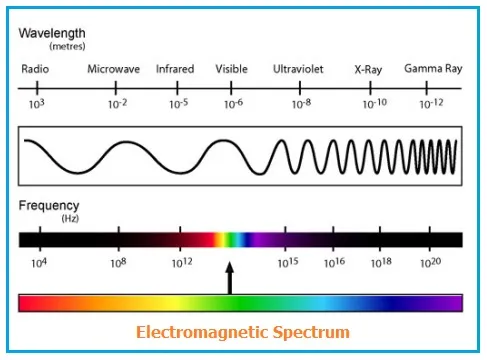
Characteristics of RF
- Covers a very wide frequency spectrum.
- Can be transmitted through free space or guided media.
- Lower frequency RF waves can travel long distances by ground wave or sky wave propagation.
- Circuit design is generally simpler at lower RF frequencies.
- Widely used for both analog and digital communication.
What is Microwave?
The term “micro” signifies something very small, essentially a millionth part of a unit. The term “Microwave” is used to identify EM waves above 1 GHz in frequency because of the short physical wavelength of these frequencies. Microwaves are essentially radio frequency (RF) waves. However, a difference between RF and microwave exists as far as operating range and applications are concerned. Microwaves range from 300MHz to 300GHz. Most microwave applications range up to 100 GHz.
Characteristics of Microwave
- Short wavelengths (approximately 30 cm to 1 mm)
- High antenna gain and directivity
- Large Bandwidth
- It travels by LOS (Line Of Sight)
- Low noise level in the 1-10 GHz range, allowing for the easy detection of very low signals at the receiver
- Microwaves penetrate the ionosphere with less attenuation and distortion
What is the difference Between RF and Microwave?
Although engineers often use the terms RF and Microwave interchangeably, there are slight distinctions between them, as highlighted below. While the starting range of microwaves can be ambiguous, it generally starts from 1 GHz and spans up to 1 Tera-Hertz. This corresponds to wavelengths ranging from 30 cm to 0.3 mm.
| Specifications | RF | Microwave |
|---|---|---|
| Frequency range (Hz) | 3 KHz to 300 GHz | 300 MHz to 300 GHz (Subset of RF) |
| Wavelength | Longer wavelength, 1 mm to 100 Km | Shorter wavelengths, 1 mm to 1 m |
| Signal Behavior | Longer range, less prone to attenuation | Shorter range, more susceptible to losses |
| Propagation | Easily propagates through obstacles like walls | Requires line of sight; higher attenuation |
| Power Levels | Lower power for communication systems | Higher power for applications like radar |
| Transmission Medium | Works well with both guided and unguided media | Primarily guided media (e.g., waveguides) |
| Components | RF amplifiers, antennas, modulators | Waveguides, magnetrons, circulators |
| Bandwidth | Typically narrower | Wider bandwidth, supports high data rates |
| Energy Density | Lower energy density | Higher energy density |
| Applications | Mobile, AM/FM radio, television | radar, satellite and space communication |
Summary
While microwave technology is technically a subset of the broader RF spectrum, it offers distinct advantages in data throughput and line of sight propagation. Differentiating between the two helps engineers properly allocate frequency bands for broadcast television versus high speed satellite links.
Continue Learning RF Technology
- What is RF Signal : Radio Frequency Fundamentals
- RF Related Terminologies
- RF Components & Their Basic Functions, Manufacturers
- What is RF Radiation: Safety, Uses & Health Concerns
Compare RF (Radio Frequency) with The Rest
- RF Vs. Baseband : Key Differences Explained
- RF Vs. IF: Difference Between RF and IF Signals
- RF Vs. PHYSICAL LAYER : Key differences explained