
What are RF vs. Baseband: Key Differences Explained
Advertisement
The key difference between RF and baseband signals is their frequency range and modulation status. A baseband signal is the original, low frequency data (like audio or digital bits) before any modulation occurs. In contrast, an RF (Radio Frequency) signal is a high frequency carrier wave that has been modulated with the baseband data for long-distance wireless transmission.
The comparison between RF (Radio Frequency) and Baseband is fundamental to understanding modern communication technology. RF refers to the high frequency signals used for wireless transmission, whereas Baseband deals with the original, lower frequency signal before it’s modulated for transmission.
What is RF (Radio Frequency) ?
-
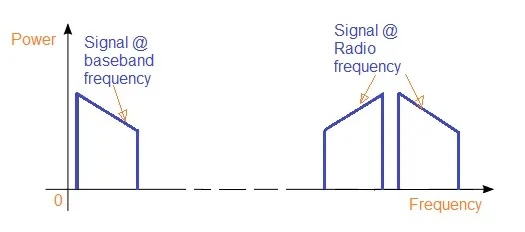
Definition: Radio frequencies are those higher frequencies typically ranging from 3 kHz to 300 GHz, as illustrated in Figure 1.
-
The RF spectrum is divided into different bands, from ELF (Extremely Low Frequency) to EHF (Extremely High Frequency).
-
Modulation: RF signals undergo modulation before transmission to efficiently transmit information.
-
Filtering: Band-pass filters (BPF) are employed to isolate the desired RF signal, which is subsequently downconverted to a baseband signal to recover the original information.
-
RF to Baseband Conversion: This conversion is achieved using heterodyne or homodyne architectures that rely on RF mixers.
-
Transmission Channels: Various types of transmission lines and coaxial cables serve as RF channels for transmitting RF signals.
Applications of RF
-
RF is utilized for transmitting voice and data wirelessly after converting them to suitable RF frequencies, in accordance with various wireless technologies like WLAN, WiMAX, GSM, CDMA, LTE, Zigbee, Z-wave, LoRa, etc. Each technology operates within specific frequency bands based on link budget requirements.
-
RF plays a crucial role in numerous medical applications such as RF ablation, skin tightening, spectroscopy, telemetry, and Wireless Body Area Networks (WBANs).
-
RF is implemented in home automation systems, automatic car parking facilities, and automated meter reading systems.
-
Radio frequencies are preferred for over-the-air transmission because they can withstand channel impairments that would severely impact baseband signals.
What is Baseband Frequency ?
-
Definition: A baseband signal is characterized by a non-zero magnitude near zero frequency, with a negligible magnitude at other frequencies. This is also depicted in Figure 1.
-
Bandwidth: The bandwidth of a baseband signal equals the highest frequency component present in the signal.
-
OSI Model: Baseband is often referred to as the physical layer, corresponding to OSI layer 1.
-
Modulation: Baseband signals are not modulated before transmission.
-
Filtering: Low-pass filters (LPF) are used to extract baseband information, as it resides near zero frequency.
-
Baseband to RF Conversion: Conversion from baseband to RF utilizes heterodyne or homodyne-based architectures with RF mixers.
-
Transmission Channels: Serial cables and twisted-pair cables commonly found in LANs are examples of baseband channels used for transmitting baseband signals.
-
Transmission Suitability: Baseband signals are not well-suited for over-the-air transmission and are primarily used for wired communication.
Applications of baseband
- Ethernet physical layer standards like 10Base5 and 100Base-Tx.
- Baseband signal processing in DSPs or FPGAs, which encompasses the physical layer of various wired and wireless standards.
- The output of an ADC (Analog to Digital Converter) typically contains information at baseband frequencies.
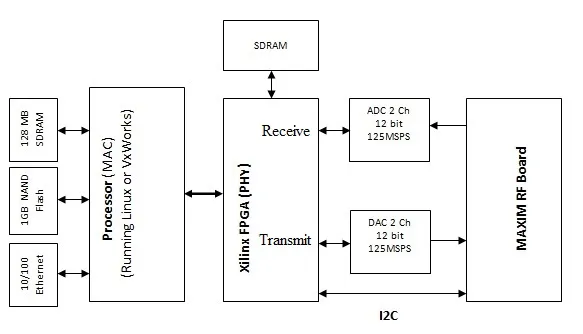
The figure illustrates the interface between RF and PHY layers using ADC/DAC.
Summary
Understanding the transition from baseband to RF is essential for grasping how digital data is successfully transmitted over the air. Baseband represents the raw intelligence, while the RF carrier acts strictly as the high frequency delivery vehicle.
Continue Learning RF Technology
- What is RF Signal : Radio Frequency Fundamentals
- RF Related Terminologies
- RF Components & Their Basic Functions, Manufacturers
- What is RF Radiation: Safety, Uses & Health Concerns
Compare RF (Radio Frequency) with The Rest
- RF Vs. Microwave : Key Comparison
- RF Vs. IF: Difference Between RF and IF Signals
- RF Vs. PHYSICAL LAYER : Key differences explained