
What is RF Radiation: Safety, Uses & Health Concerns
Advertisement
RF radiation is a type of non-ionizing electromagnetic energy emitted by wireless devices like cell phones, Wi-Fi routers, and broadcasting towers. Unlike ionizing radiation (such as X-rays), RF radiation lacks the energy to alter human DNA. While generally safe under FCC guidelines, common health concerns focus on prolonged exposure and tissue heating, making strict regulatory safety standards essential.
RF radiation is a type of non-ionizing electromagnetic energy widely used in communication systems. Radio frequency waves range from 3 KHz to about 300 GHz. RF radiation happens due to electrical oscillations of the E and H field. This emission of radio frequency waves (Electromagnetic waves) from various transmission devices is referred to as RF radiation.
An antenna is the device used to radiate RF energy in the form of E-M waves in the air when antenna impedance becomes equal to the free space impedance (377 Ohm).
Figure shows electromagnetic rf radiations from mobile and Cellular tower.
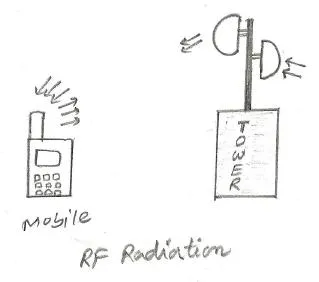 RF radiation
What is HERP (Hazards of Electromagnetic Radiation to Personnel) ?
There are numerous applications of microwave signals in medical treatment for the human body. However, exposure of high microwave power to human bodies is hazardous and will cause skin cancer, headaches, dizziness, cataracts, birth defects in newborns, increased stress, and more diseases.
HERP, i.e., Hazards of Electromagnetic Radiation to Personnel, is caused by the thermal effect of radiated RF/Microwave energy. Microwave energy directed on the body may be scattered, reflected, and absorbed depending upon the field strength, frequency, and dimension of the human body.
The absorbed microwave energy produces molecular vibration and converts this energy into heat. This is also referred to as microwave heating.
Significant energy absorption will occur when body size is at least th of the wavelength of microwave frequency radiated. where is speed of light and is the frequency.
RF Radiation Hazard Limits
Various agencies have defined safety limits/standards for RF radiation exposure. IRPA (International Radiation Protection Association) sets the permissible exposure levels for the general public. The limits take care of skin depth and specific absorption rate. ANSI developed the electromagnetic hazard limit of HERP.
Various countries such as USSR, CANADA, US, and Sweden have their exposure standards which define the exposure limit with application duration and radio frequency. As per the US Navy, personnel should not be exposed to a power density above 10 mW/cm², for a duration of 0.1 hours and a frequency range of 10 MHz - 100 GHz.
This limit goes to 100 mW/cm² when the exposure is not continuous.
Summary
Understanding RF radiation safety guidelines helps consumers and engineers mitigate potential health concerns associated with modern wireless technologies. Adhering to established regulatory limits ensures that long-term exposure to non-ionizing electromagnetic fields remains completely harmless.
Continue Learning RF Radiation
- Ionizing Vs. Non-Ionizing Radiation : Key Differences
- EM Radiation Standards and Mitigation Techniques
- Terahertz radiation basics and sources
- Gamma Radiation Examples, Advantages & Disadvantages
- Microwave Radiation : Examples, Advantages & Disadvantages