
RF vs IF: Difference Between RF and IF Signals
Advertisement
The primary difference between RF and IF signals is their role in wireless reception. An RF (Radio Frequency) signal is the high frequency wave transmitted through the air. An IF (Intermediate Frequency) signal is a lower, fixed frequency wave created inside a superheterodyne receiver by mixing the RF signal with a local oscillator, allowing for easier filtering and amplification.
RF vs IF is a common topic in communication engineering. RF (Radio Frequency) covers high frequency signals for transmission, while IF (Intermediate Frequency) bridges RF and baseband processing by lowering the frequency for better signal handling. RF and IF are terms commonly used in the context of radio communication and signal processing, especially in the design of radio receivers.
IF to RF and RF to IF conversion can be done using a device called RF mixer. The same conversion can be achieved by way of single conversion or dual conversion.
What is Radio Frequency (RF)?
Definition: RF refers to the range of electromagnetic frequencies associated with radio wave propagation. This range typically spans from a few kilohertz (kHz) to several gigahertz (GHz).
Purpose: In the context of radio communication, RF is used to transmit and receive signals wirelessly. RF signals are used for various purposes, including broadcasting, wireless communication, radar systems, and more.
What is Intermediate Frequency (IF)?
Definition: IF is an intermediate frequency used in the signal processing chain of a radio receiver. It is an intentionally chosen frequency that is different from both the RF and the audio frequencies.
Purpose: The use of IF in a radio receiver provides several advantages. It helps to improve selectivity, sensitivity, and ease of amplification of the incoming signal. The process of converting the RF signal to a lower IF simplifies the design of the receiver, making it more manageable and cost-effective.
Following table mentions intermediate frequencies(IF) typically used for different applications such as RF test Equipments, Radar, Satellite equipments, microwave equipments, AM/FM radio, television(TV) etc.
| Type of application | Intermediate Frequency value |
|---|---|
| RF test equipments | 21.4MHz, 160MHz, 310.7MHz |
| Radar | 30MHz |
| Satellite Equipments | 70MHz for C band up converter and down converter; 140MHz for Ku Band; 950 to 1450MHz for L Band Equipments and Systems |
| Microwave Equipments | 70MHz, 75MHz, 250MHz |
| AM Radio(Values are in KHz) | 450, 455, 460, 465, 467, 470, 475, 480 |
| FM Radio | 262KHz, 455KHz, 1.6MHz, 5.5MHz, 10.7MHz, 10.8MHz, 11.2MHz, 11.7MHz, 11.8MHz, 21.4MHz, 75MHz, 98MHz. |
| Analog Television | 41.25MHz for audio and 45.75MHz for video in TV system M; 33.4MHz(Aural) and 38.9MHz(Visual) in TV system B |
| Broadcast Receiver | 110KHz |
- Table-1 : IF values for different applications
Up Converter and Down Converter Design using RF Mixer
IF to RF conversion is achieved using a RF device called Up converter (“UC”). Similarly RF to IF conversion is achieved using RF device called Down converter (“DC”).
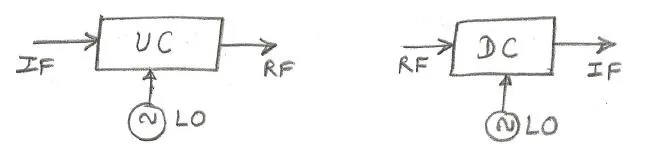
Heterodyne and homodyne receiver architectures are used to convert modulated RF signal to IF signal. Superheterodyne uses 10.7MHz as first IF and 470KHz as second IF.
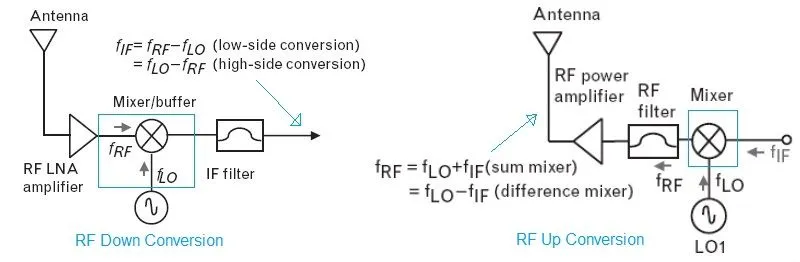
The figure-2 depicts use of RF mixer for up/down conversion.
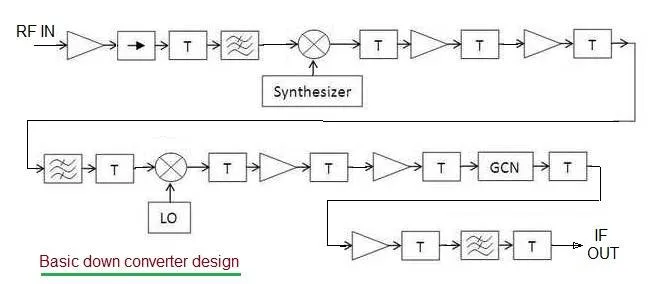
RF to IF conversion
Following are the signal processing steps involved at receiver for RF to IF conversion and voice/data recovery.
- The incoming RF signal is mixed with a local oscillator (LO) frequency to produce the IF signal. This process is also known as downconversion.
- The IF signal is then processed through filters and amplifiers to enhance the desired signal and reject unwanted frequencies.
- The final stage involves demodulating the IF signal to recover the original audio or data signal.
IF to RF conversion
Following are the steps involved at transmitter for IF to RF conversion for transmission of voice/data into the air using antenna.
- Incoming modulated IF from modem is mixed with a LO to produce RF signal. This process is also known as upconversion.
- RF signal is the processed through filters (BPF) and amplifiers to enhance desired signal and reject unwanted frequencies.
- The amplified RF signal is passed through power amplifier (PA) before transmission into the air using RF antenna.
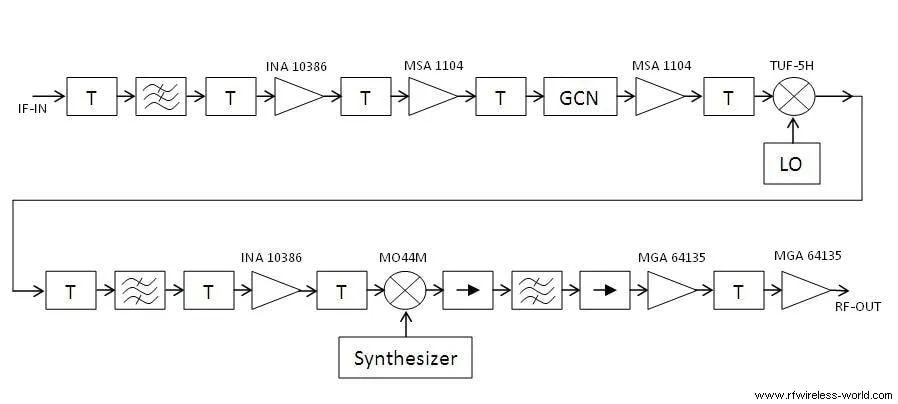
The circuit consists of discrete rf components such as RF mixers, rf filters, rf isolators, chip resistors and capacitors, MMICs etc.
Difference between RF and IF
| Feature | RF (Radio Frequency) | IF (Intermediate Frequency) |
|---|---|---|
| Frequency range | Broad range, 3 kHz to 300 GHz | Specific frequency, chosen within the receiver, as shown in table-1. |
| Key role | Enables wireless signal transmission. | Acts as an intermediary stage to process signals before final demodulation. |
| Signal manipulation | Carries information for transmission | Signal is down converted for processing |
| Frequency conversion | No intentional conversion required at RF stage | RF signal is mixed with LO to produce IF (Intermediate Frequency) |
| Original signal | Transmitted or received at the RF frequency | Downconverted to IF before further processing |
| Bandwidth | Varies widely depending on the application. | Narrower and standardized bandwidth for efficient filtering and amplification. |
| Losses | Higher losses due to propagation over long distances. | Lower losses as signals are processed locally within devices. |
| Components | Includes antennas, RF amplifiers, and RF filters. | Includes mixers, oscillators, and IF amplifiers. |
| Energy Consumption | Requires more power for high frequency transmission. | Consumes less power compared to RF. |
Summary
Converting an incoming RF wave into an IF signal drastically improves a receiver’s ability to filter out noise and isolate specific channels. This intermediate step is the defining architecture that makes modern superheterodyne communication systems incredibly reliable.
Continue Learning RF Technology
- What is RF Signal : Radio Frequency Fundamentals
- RF Related Terminologies
- RF Components & Their Basic Functions, Manufacturers
- What is RF Radiation: Safety, Uses & Health Concerns
Compare RF (Radio Frequency) with The Rest
- RF Vs. Microwave : Key Comparison
- RF Vs. Baseband : Key Differences Explained
- RF Vs. PHYSICAL LAYER : Key differences explained