
2-Wire vs. 4-Wire Circuits: Telephone System Differences Explained
Advertisement
This page explains the difference between 4W and 2W telephone circuits. These terms are commonly used when discussing telephone systems.
- 4W stands for 4 Wire.
- 2W stands for 2 Wire.
2W Circuit Explained
Two wires are typically used between a telephone subscriber’s terminal (the phone itself) and the analog line interface (usually at the central office or exchange). This design minimizes the cost of the line cable. Importantly, both transmission (sending your voice) and reception (hearing the other person) occur over these same two wires of the local loop.
4W Circuit Explained
Four wires are used for longer distance trunks connecting different exchange branches. The reason for using four wires in this scenario is to isolate the transmitted and received signals from each other.
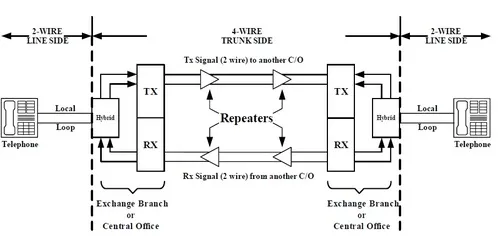
Image alt: 2W 4W telephone hybrid circuit
Hybrid Transformer: Making 2W and 4W Work Together
The separation of transmit and receive signals in the analog line interface at the central office (CO) is accomplished using a hybrid transformer. For example, the Motorola MC3419 IC can function as a hybrid transformer.
Continue Learning Telephony, PBX & EPABX Systems
- Telephone System Basics
- EPABX Explained: A Beginner’s Guide
- Signaling Types in EPABX / PBX Systems
- PBX vs Virtual PBX
- Cordless Telephone System Basics
- Computer Telephony Integration
Explore Cloud & IP Telephony
- Cloud PBX Phone Systems: Advantages & Disadvantages
- Cloud Telephony Explained
- IP Telephone System Basics