
What is HBM Memory : Advantages and Disadvantages
Advertisement
High Bandwidth Memory (HBM) is an advanced memory technology that stacks DRAM dies vertically to achieve extremely high data transfer rates and energy efficiency. It is widely used in AI accelerators, GPUs, and high-performance computing systems. Advantages include massive bandwidth and reduced power consumption, while disadvantages include higher costs and manufacturing complexity.
Introduction: HBM (High Bandwidth Memory) is manufactured by companies like Hynix and Samsung and is found in certain graphics cards produced by AMD and NVIDIA.
Key features of HBM Memory
HBM utilizes a non-planar memory design with a 3D structure, resembling a cube or cuboid. This design involves stacking multiple memory chips to form a cube, which results in:
- Smaller footprint.
- Ability to be mounted closer to the GPU.
- Faster processing due to the proximity.
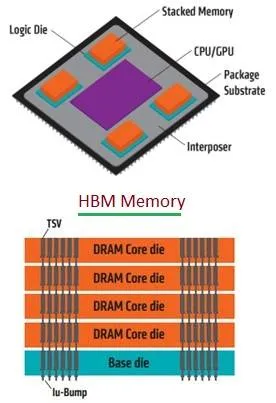
Typically, an HBM memory stack consists of four DRAM dies on a single base die. A graphics card with four stacks supports a memory bus width of 4096 bits, as each HBM stack supports 1024 bits.
HBM2 and HBM3 are the latest versions of this memory. HBM2 consists of 8 DRAM dies per stack and supports transfer rates up to 2.4 Gbps. The NVIDIA Tesla P100 was among the first GPU chips to use HBM2 memory.
It’s commonly used in memory-intensive applications like AR and VR gaming. HBM2 supports a maximum capacity of 4GB/8GB per stack. HBM3 is even faster than HBM2, consumes less power, and offers higher capacity, allowing for 64GB VRAM on graphics cards with a memory bandwidth of up to 512 GB/s per stack.
Advantages of HBM Memory
- Low Power Consumption: HBM offers lower power consumption compared to GDDR5 and GDDR5x.
- Small Form Factor: Its compact size allows for higher density compared to GDDR memory.
- High Memory Bandwidth: It provides higher memory bandwidth (>100 GB/s) than GDDR5 memory (up to 28 GB/s per chip).
- High Capacity: It supports higher capacity, around 4GB or 8GB per stack.
- Reduced Heat: HBM doesn’t generate as much heat.
- Low Latency: It can be placed close to the GPU die, resulting in lower latency.
- Better Performance: HBM delivers superior performance overall. Its operating speed is 1 Gbps.
Disadvantages of HBM Memory
- High Cost: HBM is relatively expensive.
- Limited Availability: It’s not as widely available on graphics cards as other memory types.
Summary
HBM memory enhances AI and graphics performance through ultra-high bandwidth architecture. Advantages include speed and energy efficiency, while disadvantages include higher production costs and packaging complexity.
Explore Core Memory Concepts & Fundamentals
- Mobile Phone Memory Overview
- RAM vs Cache Memory
- L1 vs L2 vs L3 Cache Memory
- ARM Bus Technology, Memory Types and Peripherals
Continue Learning RAM (Random Access Memory) Architectures & Types
Deep dives into the volatile memory used for active processing, including DDR, Graphics RAM, and emerging MRAM technologies.
- SRAM vs DRAM Memory
- Understanding DDR1 to DDR4 SDRAM
- LPDDR Generations Comparison
- LPDDR5 RAM: Advantages & Disadvantages
- GDDR Memory: Advantages & Disadvantages
- HBM Memory: Advantages & Disadvantages
- MRAM Technology: Types, Benefits, Drawbacks
- Ferroelectric RAM (FRAM) Basics