
What is GDDR Memory : Advantages and Disadvantages & Types
Advertisement
Graphics Double Data Rate (GDDR) memory is a high speed memory technology specifically designed for graphics cards, AI accelerators, and gaming systems. It delivers significantly higher bandwidth than conventional DRAM for graphics-intensive workloads. Advantages include exceptional data throughput and graphics performance, while disadvantages include higher power consumption and increased heat generation.
Key Features of GDDR Memory
- GDDR is a type of SDRAM (Synchronous Dynamic RAM) specifically designed for video cards.
- Various versions exist, including GDDR1 to GDDR5, GDDR5X, and GDDR6.
- It offers more advantages compared to DDR memory, which uses two data transfers per cycle.
- GDDR5 is a widely used, high-performance memory found in many existing graphics cards.
- It’s used in various budget-friendly graphics cards like the GTX 1060/1070, Radeon RX 480, GT 730/740, and RX 460.
- GDDR memories are manufactured by companies like Samsung, Hynix, ELPIDA, and Micron.
- GDDR5 chips come in sizes like 512 MB, 1 GB, 2 GB, 4 GB, and 8 GB.
- Furthermore, GDDR5 supports a 32-bit wide bus width.
- It has a square or rectangular appearance.
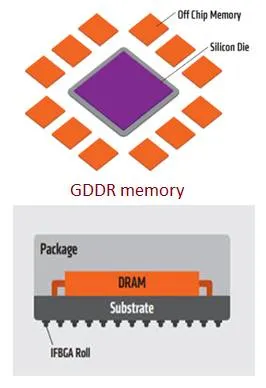
The figure shows the structure of a GDDR5 memory type.
GDDR Memory Types
The following table compares different GDDR memory types in terms of memory clock and transfer rate.
| Chip Type | Memory Clock | Transfer/s | Transfer Rate |
|---|---|---|---|
| GDDR2 | 500 MHz | 128 Gbit/s | 16 GB/s |
| GDDR3 | 625 MHz | 2.5 GT/s | 159 Gbit/s 19.9 GB/s |
| GDDR4 | 275 MHz | 2.2 GT/s | 140.8 Gbit/s 17.6 GB/s |
| GDDR5 | 625 to 1000 MHz | 5 to 8 GT/s | 320 to 512 Gbit/s 40 to 64 GB/s |
| GDDR5X | 625 to 875 MHz | 10 to 12 GT/s | 640 to 896 Gbit/s 80 to 112 GB/s |
| GDDR6 | 875 to 1000 MHz | 14 to 16 GT/s | 896 to 1024 Gbit/s 112 to 128 GB/s |
Source : https://en.wikipedia.org/
Advantages of GDDR Memory
Following are the benefits of using GDDR memory:
- Higher Bandwidth: GDDR offers significantly higher bandwidth due to a wider memory bus.
- Lower Power and Heat: It generally has lower power consumption and heat dispersal requirements compared to DDR memory.
- High Performance, Simple Cooling: It enables high-performance modules with simpler cooling systems than DDR memory.
- Higher Capacity: GDDR offers higher maximum capacity compared to DDR memory.
- Faster Operations: It provides higher speed and faster operations than DDR memory.
- Widespread Use: It’s widely used on various graphics cards from numerous manufacturers.
Disadvantages of GDDR Memory
Following are the drawbacks of using GDDR memory:
- Higher Cost: GDDR is typically more expensive than DDR memory types.
- Heat Dissipation (Specific Versions): Certain GDDR versions, like GDDR5X, can dissipate more heat and may require thermal pads.
- Larger PCB Footprint: It requires more space on the PCB (Printed Circuit Board), leading to larger card sizes.
- Lower Density: Its density is lower, often necessitating multiple modules around the GPU.
Summary
GDDR memory enhances graphics and AI processing with high bandwidth data transfer. Advantages include superior performance and speed, while disadvantages include higher power requirements and thermal challenges.
Explore Core Memory Concepts & Fundamentals
- Mobile Phone Memory Overview
- RAM vs Cache Memory
- L1 vs L2 vs L3 Cache Memory
- ARM Bus Technology, Memory Types and Peripherals
Continue Learning RAM (Random Access Memory) Architectures & Types
Deep dives into the volatile memory used for active processing, including DDR, Graphics RAM, and emerging MRAM technologies.
- SRAM vs DRAM Memory
- Understanding DDR1 to DDR4 SDRAM
- LPDDR Generations Comparison
- LPDDR5 RAM: Advantages & Disadvantages
- GDDR Memory: Advantages & Disadvantages
- HBM Memory: Advantages & Disadvantages
- MRAM Technology: Types, Benefits, Drawbacks
- Ferroelectric RAM (FRAM) Basics