
What is Phase Change Memory (PRAM): Advantages and Disadvantages
Advertisement
Phase Change Memory (PRAM or PCM) is a non-volatile memory technology that stores data by changing the physical state of chalcogenide materials between amorphous and crystalline forms. It offers fast read speeds, high endurance, and persistent data storage for emerging computing applications.
Characteristics or Features of Phase Change Memory
Phase Change Memory leverages the unique properties of chalcogenide glass. This material can be switched between two states – crystalline and amorphous – by applying heat. The transition between these phases is precisely controlled through heating and cooling processes.
Compared to flash memory, PRAM offers superior switching speeds and inherent scalability. Flash memory faces limitations like scaling constraints and a limited number of write cycles. Phase change memory addresses these issues by employing reversible structural phase changes between amorphous and crystalline states. Each memory cell’s small active media volume functions as a quickly programmable resistor.
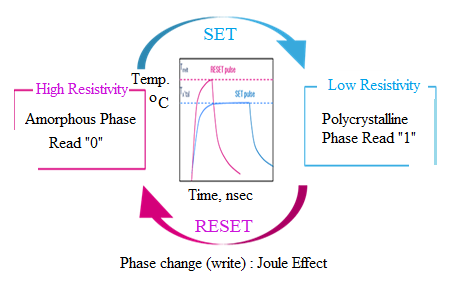
Image courtesy : ST Microelectronics
Physical Characteristics of Phase Change Memory (PRAM)
- Chemical formula: GexSbyTez
- Material: Chalcogenide glass
- Data Representation: Uses two states to represent binary data:
- Crystalline: Low Resistance, represents binary 0
- Amorphous: High Resistance, represents binary 1
- Switching Speed: On the order of nanoseconds.
- Timing: Read time is 100-300 nsec, and program time is 10-150 µs.
PCM memory exists in either an amorphous or crystalline phase, each with distinct characteristics:
Amorphous Material
- Short-range atomic order
- Low free electron density
- High activation energy
- High resistivity
Crystalline Material
- Long-range atomic order
- High free electron density
- Low activation energy
- Low resistivity
PCM Operating Principle
- PCM cells are programmed by applying a current pulse at a voltage exceeding the switching threshold.
- PCM devices are programmed by electrically altering the structure (amorphous or crystalline) of a small volume of chalcogenide alloy.
- The programming pulse drives the memory cell into a high or low resistance state (phase transition process), depending on the current magnitude or amplitude.
- The phase transition process can be completed in as quickly as 5 ns. Information stored in the cell is read out by measurement of cell’s resistance.
Benefits or Advantages of Phase Change Memory (PRAM)
- Fast Switching: Offers switching performance in the nanosecond (ns) range.
- Medium Endurance: Provides an endurance of approximately 109 to 1013 cycles.
- Low Voltage: Operates at low voltages (0.4 to 2V).
- Good Scalability: Offers better scalability compared to NVM or flash memory.
- Reduced Costs: Reduces assembly and testing costs.
- Reprogrammability: PCM cells can be reprogrammed at least 106 times.
Drawbacks or Disadvantages of Phase Change Memory (PCM)
- Temperature Sensitivity: Temperature sensitivity is a major concern in PRAM development.
- Degradation: PRAM devices degrade with use, leading to a limited lifespan, similar to flash memory.
- Proximity Heating: Managing proximity heating with declining cell space is a challenge.
- Scaling Challenges: Increased set/reset resistance and decreased read current/set current margin are challenges with scaling.
Summary
Phase Change Memory (PRAM) is a non-volatile memory technology that stores data by switching a material between crystalline and amorphous states. It combines fast performance with high endurance and long-term data retention.
Advertisement


