
What is NAND Flash Memory: Advantages and Disadvantages
Advertisement
NAND Flash memory is a non-volatile storage technology used in SSDs, USB drives, memory cards, and smartphones. It stores data without requiring continuous power and offers high storage density, fast read/write performance, and low power consumption. However, NAND Flash has limited write endurance and may experience performance degradation over time.
NAND Flash Architecture
FPGAs utilize various memory types to store configuration data, including serial NOR flash memory, parallel NOR flash memory, and NAND flash memory.
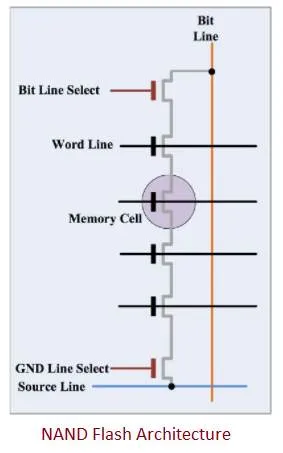
Image courtesy: Cypress Semiconductor Corporation (Now part of Infineon Technologies)
The illustration above shows the architecture of NAND flash memory. As you can see, several memory cells (around eight) are connected in series, resembling a NAND gate.
Benefits or Advantages of NAND Flash
- Low Cost Per Bit: NAND flash offers a lower cost per bit compared to NOR flash memory. This makes it a more economical choice for large storage capacities.
- Greater Capacity: NAND flash can achieve higher storage capacities than NOR flash.
- Faster Write and Erase Speeds: NAND flash provides faster write and erase speeds, making it more efficient for applications that require frequent data updates.
- Lower Power Consumption: During write, read, and erase operations, NAND flash consumes significantly less power.
- Preferred for Data Storage: NAND flash is generally preferred for data storage applications due to its cost-effectiveness and capacity.
Drawbacks or Disadvantages of NAND Flash
- Slower Random Read Speed: Compared to NOR flash, NAND flash offers slower random read speeds.
- Higher Standby Current: NAND flash exhibits higher standby current compared to NOR flash.
- Bit Flipping: Bit flipping is more common in NAND flash than in NOR flash, potentially leading to data corruption.
- Bad Block Development: The occurrence of bad blocks is more frequent in NAND flash memory, necessitating mandatory bad block handling procedures.
Summary
NAND Flash memory provides high capacity, low power, and cost effective storage for modern electronic devices. Learn the advantages and disadvantages of NAND Flash, including fast access speed, compact design, limited write cycles, and data retention considerations.