
Bluetooth Modulation: GFSK vs pi/4-DQPSK vs 8DPSK Comparison
Advertisement
Based on the Bluetooth Core Specification, Bluetooth operates in the 2.4 GHz ISM band and must constantly balance three competing factors viz. data throughput, power consumption and signal robustness. To manage this balance, the Bluetooth Classic (BR/EDR) architecture utilizes three different radio frequency (RF) modulation schemes viz. GFSK, pi/4-DQPSK and 8DPSK. While the symbol rate (i.e. number of signal changes per second) remains constant at 1 Msym/s across all three schemes, the way the data is packed into those symbols changes.
GFSK (Gaussian Frequency Shift Keying)
- It is the Foundation of Bluetooth (Basic Rate & Low Energy).
- Data mapping : GFSK encodes data by slightly changing (shifting) the frequency of the carrier wave. A shift to a slightly higher frequency represents a binary one (“1”) and a shift to a slightly lower frequency represents a binary zero (“0”). The “Gaussian” part means the data passes through a mathematical filter that smooths out the sharp transitions between the 1s and 0s. This smoothing prevents the radio signal from “splattering” into adjacent frequency channels, reducing interference.
- Data Density: Because there are only 2 states (higher frequency or lower frequency), it transmits 1 bit per symbol.
- Gross Data Rate: 1 Mbps.
- Use Case : It is the mandatory Basic Rate (BR) for Bluetooth Classic. It is also the exclusive modulation scheme used for all Bluetooth Low Energy (LE) communications. Furthermore, the Access Code and Header of every Bluetooth Classic packet is transmitted in GFSK so that all devices can at least read the header.
- Pros & Cons: It is extremely power efficient and highly robust against noise, giving it excellent range. However, it provides the lowest data throughput.
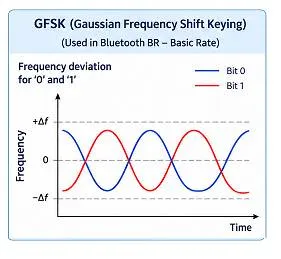 GFSK Modulator Data Mapping
pi/4-DQPSK (π/4-Rotated Differential Quaternary Phase Shift Keying)
- The First Speed Boost (Enhanced Data Rate - 2 Mbps).
- Working : Instead of changing the frequency, PSK changes the phase of the radio wave.
- Quaternary: It uses 4 distinct phase states.
- Differential: The data is not encoded in absolute phase, but rather in the difference in phase from the previous symbol. This makes the receiver hardware simpler and more reliable.
- pi/4-Rotated: The constellation of phase points rotates by 45 degrees (pi/4 radians) with each symbol. This clever trick prevents the signal amplitude from dropping to zero during phase transitions, which allows the radio’s power amplifier to run more efficiently.
- Data Density: Because there are 4 distinct phase states, it can transmit 2 bits per symbol (e.g. 00, 01, 10, 11).
- Gross Data Rate: 2 Mbps.
- Use Case: Bluetooth Enhanced Data Rate (EDR).
- Pros & Cons: It doubles the data rate without needing more radio bandwidth. However, detecting subtle phase shifts requires a more complex, linear and power hungry amplifier than GFSK.
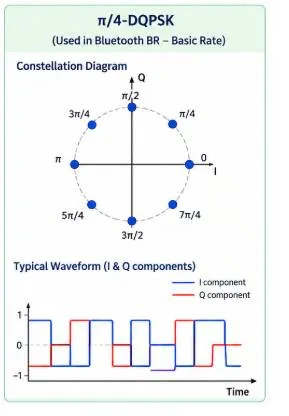 pi/4 DQPSK Modulator
8DPSK (Differential 8-ary Phase Shift Keying)
- Maximum Classic Speed (Enhanced Data Rate - 3 Mbps)
- Working : This is an evolution of the previous scheme. It uses the exact same concept of differential phase shifting, but instead of 4 phase states, it divides the radio wave into 8 distinct phase states.
- Data Density: Because 2^3 = 8, having 8 states allows the radio to pack 3 bits per symbol into the transmission (e.g. 000, 001, 010, up to 111).
- Gross Data Rate: 3 Mbps.
- Use Case : The highest tier of Bluetooth Enhanced Data Rate (EDR).
- Pros & Cons: It triples the baseline data rate, allowing for high quality audio streaming and faster file transfers. The downside is that packing 8 phase states into a single wave means the states are mathematically “closer” together. This makes it much easier for background noise to cause a misread (a bit error). Therefore, 8DPSK requires a very clean, strong signal (high Signal to Noise Ratio) to work properly and has a shorter effective range than GFSK.
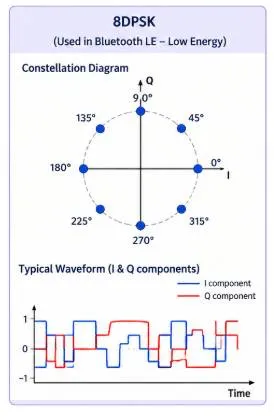 8DPSK Modulator
The EDR Packet Quirk: A Hybrid Approach
It is important to note that an EDR packet does not use PSK modulation for the entire transmission. To ensure backward compatibility, an EDR packet actually starts with GFSK to transmit the Access Code and Packet Header. After the header, there is a tiny microsecond “Guard Time” where the radio switches its modulation circuitry and then the actual payload data is transmitted using either pi/4-DQPSK or 8DPSK.
Difference between GFSK vs pi/4-DQPSK vs 8DPSK
| Feature | GFSK | π/4-DQPSK | 8DPSK |
|---|---|---|---|
| Modulation Variable | Frequency | Phase | Phase |
| States / Constellation | 2 States (High/Low Freq) | 4 Phase States | 8 Phase States |
| Bits per Symbol | 1 bit / symbol | 2 bits / symbol | 3 bits / symbol |
| Symbol Rate | 1 Msym/s | 1 Msym/s | 1 Msym/s |
| Gross Data Rate | 1 Mbps | 2 Mbps | 3 Mbps |
| Bluetooth Designation | Basic Rate (BR) & Low Energy (LE) | Enhanced Data Rate (EDR) | Enhanced Data Rate (EDR) |
| Power Efficiency | Highest: Uses non-linear amplifiers that consume very little power. | Medium: Requires more complex, linear amplification. | Lowest: Requires highly linear amplification to maintain phase accuracy. |
| Noise Tolerance / Range | High: Very resilient to interference, longest effective range. | Medium: Phase shifts are distinct enough to handle moderate noise. | Low: Phase states are crowded; requires a very clean signal (shorter range). |
| Used For | All LE data, Classic control signals, Classic packet headers, basic audio. | Moderate data transfer, standard A2DP audio streaming. | High throughput data, high bitrate A2DP audio. |
References & Further Reading
- Bluetooth SIG : Bluetooth Core Specification Version 6.3, May 5, 2026.
- Bluetooth SIG : Bluetooth Technology Overview
Continue Learning FSK, GFSK (Gaussian Frequency Shift Keying), DQPSK & DPSK
Explore filtered variant of FSK, which is widely used in modern low power protocols like Bluetooth to reduce sideband interference. Also explore how differential phase modulation works. By measuring the phase difference between successive symbols rather than an absolute reference, these schemes simplify receiver design.
- ASK Vs. FSK Vs. PSK : Difference between Digital Modulation Techniques
- GFSK Modulation: Advantages & Disadvantages
- GFSK vs FSK: What’s the Difference?
- GFSK vs GMSK: Key Differences
- QPSK Vs. OQPSK Vs. PI/4 QPSK
- DPSK Modulation and Demodulation Basics
- DPSK vs BPSK: Understanding the Differences
- QPSK vs DQPSK (Differential Quadrature Phase Shift Keying)
Continue Learning Bluetooth Basic Concepts
- What are new features in Bluetooth 6.3 Version
- Bluetooth GATT Vs. ATT Vs. GAP : Key Comparison
- Bluetooth Service Vs. Characteristic Vs. Descriptor
- Bluetooth pairing Vs. Bonding Phase
- Bluetooth Notifications Vs. Indications
- Bluetooth Channel Sounding Vs. RSSI
- Bluetooth Direction Finding Methods : AoA Vs. AoD
- Bluetooth Error Codes Guide : Meanings, Causes & Fixes
- Bluetooth L2CAP and HCI : Key Differences
Continue Learning Bluetooth Technology
- Bluetooth Basics Tutorial
- Bluetooth Low Energy (BLE) Basics Tutorial
- Bluetooth Protocol Stack & Device State Diagram
- Bluetooth Physical Layer Modules
- Bluetooth MAC Layer Overview
- Bluetooth Channel Frequency List
- Bluetooth Network Security
- Bluetooth Low Energy (BLE) Connection Establishment Procedure
- Bluetooth Profiles: HFP, HSP, A2DP, AVRCP, PBAP & MAP
- Bluetooth Mesh Node Types & Protocol Stack Layer Functions
Compare Bluetooth With Other Technologies
- Bluetooth V5.0 Vs. V5.1 Vs. V5.2 Vs. V5.3
- Bluetooth Vs BLE : Key Differences
- Bluetooth Vs UWB Technology : Key Differences
- Bluetooth Vs Wi-Fi Vs UWB
- Comparison Between All Bluetooth Versions from 1.0 to 6.3
Explore Deep Insight Bluetooth Technology
- Bluetooth AFH Explained: Adaptive Frequency Hopping & FAQs
- Bluetooth Error Recovery : ARQ, ACK, NAK
- Bluetooth Bit Stream Processing: HEC, CRC, FEC & More
- Bluetooth Routing: How Devices Know a Packet is for Them
- Bluetooth Flow Control: Understanding GO & STOP Bits
- Bluetooth Power Management: Sniff, Hold & Active Modes
- Bluetooth Packets Decoded: Structure, Types & Routing
- Decoding Bluetooth Packet Types: Control, ACL, SCO & eSCO