
BPSK, QPSK, 16QAM, and 64QAM Modulation in Python
By RF Wireless Expert Team
Advertisement
This document provides Python code for BPSK, QPSK, 16QAM, and 64QAM modulation schemes.
Introduction:
Digital modulation techniques, such as QPSK, 16QAM, and 64QAM, enhance bandwidth efficiency by mapping multiple bits onto a single carrier. BPSK is known for its robustness and is often employed in long-distance communication and pilot subcarrier mapping.
Python Script for Data Mapping/Modulation
The following Python code can map digital binary data according to different modulation constellation points like BPSK, QPSK, 16QAM, and 64QAM.
# Binary data generator (1's and 0's as per user defined length)
import random
import numpy as np
import numpy
import matplotlib.pyplot as plt

# Python code to generate binary stream of data
input_data = ""
len1 = 1000  # length of input data
for i in range(len1):
    temp1 = str(random.randint(0, 1))
    input_data += temp1
print(input_data)

input_data1 = [int(i) for i in input_data]  # convert string to list
print(input_data1)

# Setting up parameters such as modulation type, number of bits per carrier (nc) and norm_factor
modulation_type = int(input("Enter modulation type (0: BPSK, 1: QPSK, 2:16QAM, 3: 64QAM: "))
print(modulation_type)

norm_factor = [1.0, 0.7071, 0.3162, 0.1543]
nc = [1, 2, 4, 6]

k = norm_factor[modulation_type]
print(k)

mode = nc[modulation_type]
print(mode)

M0 = []
match mode:
    case 1:
        M0 = np.array([1, -1])
        i = len(M0)
        b = np.zeros(i)
        for i in M0:
            M0 = numpy.multiply(M0, k)
        plt.plot(M0.real, M0.imag, "g*")
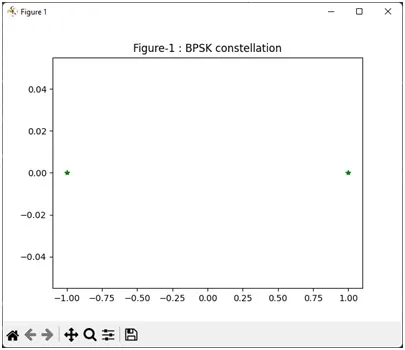
        plt.title("Figure-1 : BPSK constellation")
        plt.show()
    case 2:
        M0 = np.array([1. + 1.j, -1. + 1.j, 1. - 1.j, -1. - 1.j])
        i = len(M0)
        b = np.zeros(i)
        for i in M0:
            N0 = numpy.multiply(M0, k)
        plt.plot(M0.real, M0.imag, "g*")
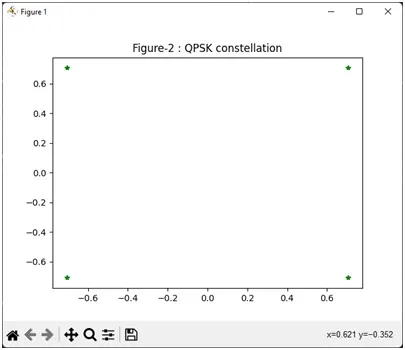
        plt.title("Figure-2 : QPSK constellation")
        plt.show()
    case 4:
        M0 = np.array([1. + 1.j, 1. + 3.j, 1. - 1.j, 1. - 3.j, 3. + 1.j, 3. + 3.j, 3. - 1.j, 3. - 3.j, -1. + 1.j, -1. + 3.j, -1. - 1.j, -1. - 3.j, -3. + 1.j, -3. + 3.j, -3. - 1.j, -3. - 3.j])
        i = len(M0)
        b = np.zeros(i)
        for i in M0:
            M0 = numpy.multiply(M0, k)
        plt.plot(M0.real, M0.imag, "g*")
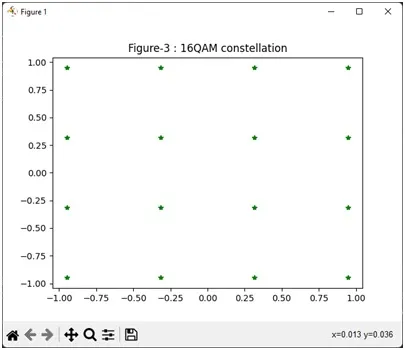
        plt.title("Figure-3 : 16QAM constellation")
        plt.show()
    case 6:
        M0 = np.array([3 + 3j, 3 + 1j, 3 + 5j, 3 + 7j, 3 - 3j, 3 - 1j, 3 - 5j, 3 - 7j, 1 + 3j, 1 + 1j, 1 + 5j, 1 + 7j, 1 - 3j, 1 - 1j, 1 - 5j, 1 - 7j, 5 + 3j, 5 + 1j, 5 + 5j, 5 + 7j, 5 - 3j, 5 - 1j, 5 - 5j, 5 - 7j, 7 + 3j, 7 + 1j, 7 + 5j, 7 + 7j, 7 - 3j, 7 - 1j, 7 - 5j, 7 - 7j, -3 + 3j, 3 + 1j, -3 + 5j, -3 + 7j, -3 - 3j, -3 - 1j, -3 - 5j, -3 - 7j, -1 + 3j, -1 + 1j, -1 + 5j, -1 + 7j, -1 - 3j, -1 - 1j, -1 - 5j, -1 - 7j, -5 + 3j, -5 + 1j, -5 + 5j, -5 + 7j, -5 - 3j, -5 - 1j, -5 - 5j, -5 - 7j, -7 + 3j, -7 + 1j, -7 + 5j, -7 + 7j, -7 - 3j, -7 - 1j, -7 - 5j, -7 - 7j])
        i = len(M0)
        b = np.zeros(i)
        for i in M0:
            M0 = numpy.multiply(M0, k)
        plt.plot(M0.real, M0.imag, "g*")
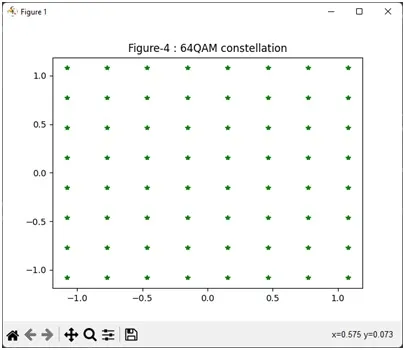
        plt.title("Figure-4 : 64QAM constellation")
        plt.show()

# checking length of data to add padding zero at the end if required
remainder = len1 % mode
print(remainder)

if remainder != 0:
    remainder = mode-remainder
    input_data1 = np.pad(input_data1, (0, remainder))
    len1 = len(input_data1)

len2 = int(len1/mode)
input_data_r = np.reshape(input_data1, (len2, mode))
print(input_data_r)

s1 = input_data
s2 = []
chunks = [s1[i:i+mode] for i in range(0, len(s1), mode)]

for piece in chunks:
    temp = int(piece, 2)
    print(temp, piece)
    s2.append(temp)

map_out = []
for value in s2:
    map_out.append(M0[value])
print(M0[value])
Input (User Interface)
The script prompts the user to select the modulation type:
Enter modulation type (0: BPSK, 1: QPSK, 2:16QAM, 3: 64QAM:)
Output Plots
The following are output plots for various modulation types based on the input provided in the Python command prompt.
BPSK Constellation Plot
QPSK Constellation Plot
16QAM Constellation Plot
64QAM Constellation Plot
Explore Python Codes on Wireless Communication & Modulation Simulations
- AM Modulation Simulation in Python
- FM Modulation in Python
- PM Modulation with Python
- ASK Modulation in Python
- FSK Modulation in Python
- PSK Modulation in Python
- QPSK Mapper / Demapper Python Code
- OFDM Transmitter Simulation in Python (WiMAX)
- Generalized OFDMA Simulation with Python
Continue Learning Modulation Types
- AM Vs. FM Vs. PM : Difference between Analog Modulation Techniques
- ASK Vs. FSK Vs. PSK : Difference between Digital Modulation Techniques
- PAM Vs. PWM Vs. PPM : Difference between Pulse Modulation Techniques
- BPSK Vs. QPSK : Key Differences
- 16-QAM Vs. 64-QAM Vs. 256-QAM : Key Differences
- 512-QAM Vs. 1024-QAM Vs. 2048-QAM Vs. 4096-QAM
- 4096QAM Modulation Used in Wi-Fi 7
- MSK Vs. GMSK : Modulation Technique used in GSM
- LORa Modulation Used in LoRaWAN
- 10% ASK & 100% ASK Modulation used in NFC
- OOK Vs. VPPM Vs. CSK : Visible Light Communication (VLC) Modulation Techniques
- QPSK Vs. OQPSK Vs. PI/4 QPSK
- PAM4 Modulation Used in Gigabit Ethernet
- CCK Vs. DSSS Vs. OFDM Used in WLAN (Wi-Fi) Standards