
What is 16-QAM, 64-QAM & 256-QAM Modulation: Key differences
Advertisement
16-QAM, 64-QAM, and 256-QAM are digital modulation schemes used in wireless communication, LTE, 5G, Wi-Fi and broadband networks. The key difference is the number of bits transmitted per symbol i.e. 4, 6 and 8 bits respectively. Higher order QAM delivers faster data rates and improved spectral efficiency but requires better signal quality and higher signal to noise ratios.
The full form of QAM is Quadrature Amplitude Modulation. It’s a digital modulation technique, specifically a combination of both Amplitude and Phase Modulation. QAM excels over QPSK in terms of data carrying capacity.
QAM leverages the concept of transmitting two signal frequencies; one shifted by 90 degrees relative to the other on the same carrier. For QAM, each carrier is ASK/PSK modulated, meaning data symbols have varying amplitudes and phases. Mathematically, this can be represented as:
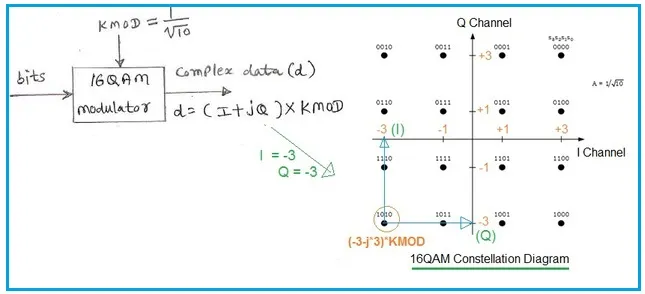
The image above illustrates the constellation points and encoding rules for 16-QAM, based on IEEE standard 802.16-2004. Let’s explore 16 QAM, 64 QAM and 256 QAM modulation types and discover key differences between them.
16-QAM, 64-QAM & 256-QAM Modulation Types
As mentioned earlier, both phase and amplitude are varied for each symbol to represent different bits. There are generally two amplitude levels (d1 and d2) for each phase. Several variations of QAM exist, with 16-QAM, 64-QAM, and 256-QAM being the most common.
Let’s take 16-QAM Modulation as an example.
In 16-QAM, each symbol represents 4 bits. This is evident in the 16-QAM constellation diagram shown above. For instance, if the input bits are “1010,” the output might be (-3 - j*3)*KMOD. KMOD, in this case, is typically 1/ for 16-QAM.
In digital modulation, the baseband signal is separated into in-phase (I) and quadrature-phase (Q) components. The combination of I and Q forms the baseband modulating signal, often represented in an IQ diagram.
The constellation diagram visually represents all possible modulated symbols used by the modulation technique to map information bits. These symbols are depicted on the complex plane, showing their amplitude and phase information.
- 64-QAM Modulation : Bits per symbol are 6. Each symbol is represented by 6 bits.
- 256-QAM Modulation : Each symbol is represented by 8 bits.
As the level increases, QAM becomes more bandwidth-efficient. However, it demands more sophisticated algorithms at the receiver to accurately decode the complex symbols back into bits. Therefore, 256-QAM is inherently more complex than 16-QAM.
QAM offers better bandwidth efficiency compared to BPSK, but it is less robust. Hence, QAM is preferred in systems with better Carrier to Interference and Noise Ratio (CINR), resulting in higher data rates. Conversely, BPSK is employed when the CINR is poor.
Difference Between 16-QAM, 64-QAM and 256-QAM
The table below summarizes the differences between 16-QAM, 64-QAM, and 256-QAM modulation techniques. The purpose of KMOD here is to achieve the same average power for all the mapped symbols (i.e. average power of 1).
| Specifications | 16-QAM modulation | 64-QAM modulation | 256-QAM modulation |
|---|---|---|---|
| Number of bits per symbol | 4 | 6 | 8 |
| Symbol rate | (1/4) of bit rate | (1/6) of bit rate | (1/8) of bit rate |
| KMOD | 1/SQRT(10) | 1/SQRT(42) | 1/SQRT(170) |
Applications of QAM (Quadrature Amplitude Modulation)
Quadrature Amplitude Modulation (QAM) is widely used in modern digital communication systems because it enables high data rates and efficient use of available bandwidth.
- Wi-Fi Networks (IEEE 802.11) : Uses 16-QAM, 64-QAM, 256-QAM, 1024-QAM, and 4096-QAM in modern Wi-Fi standards to increase wireless throughput.
- 4G LTE Networks : Employs 16-QAM, 64-QAM, and 256-QAM to improve mobile data speeds and network capacity.
- 5G NR (New Radio) : Uses up to 256-QAM and higher-order QAM schemes to deliver ultra-fast broadband and low-latency communication.
- Cable Internet (DOCSIS) : Utilizes 64-QAM, 256-QAM, 1024-QAM, and 4096-QAM for high speed broadband over cable TV infrastructure.
- Digital Television Broadcasting : Used in terrestrial, cable, and satellite TV systems to transmit high definition and ultra-high definition video.
- Optical Fiber Communication : Advanced QAM formats increase data capacity in high speed fiber optic networks and data centers.
- Microwave and Point to Point Radio Links : Enables efficient transmission of voice, video, and data over long distance wireless backhaul links.
- Satellite Communications : Used to maximize data throughput in satellite television, internet, and remote communication services.
- Software-Defined Radio (SDR) : Frequently implemented in SDR platforms for research, testing, and development of wireless systems.
- Industrial IoT and Private Networks : Supports reliable and high capacity communication in industrial automation, smart factories, and enterprise wireless networks.
Summary
As QAM order increases (16-QAM -> 64-QAM -> 256-QAM -> 1024-QAM -> 4096-QAM), data rates and spectral efficiency improve, making QAM a fundamental technology for modern broadband, wireless and multimedia communication systems.
Continue Learning Modulation Types
- AM Vs. FM Vs. PM : Difference between Analog Modulation Techniques
- ASK Vs. FSK Vs. PSK : Difference between Digital Modulation Techniques
- PAM Vs. PWM Vs. PPM : Difference between Pulse Modulation Techniques
- BPSK Vs. QPSK : Key Differences
- 16-QAM Vs. 64-QAM Vs. 256-QAM : Key Differences
- 512-QAM Vs. 1024-QAM Vs. 2048-QAM Vs. 4096-QAM
- 4096QAM Modulation Used in Wi-Fi 7
- MSK Vs. GMSK : Modulation Technique used in GSM
- LORa Modulation Used in LoRaWAN
- 10% ASK & 100% ASK Modulation used in NFC
- OOK Vs. VPPM Vs. CSK : Visible Light Communication (VLC) Modulation Techniques
- QPSK Vs. OQPSK Vs. PI/4 QPSK
- PAM4 Modulation Used in Gigabit Ethernet
- CCK Vs. DSSS Vs. OFDM Used in WLAN (Wi-Fi) Standards