
Smart Lavatory: IoT-Based Aircraft Cleanliness Monitoring
Advertisement
This page describes the architecture of an IoT-based Aircraft Lavatory Cleanliness Monitoring System. It highlights the benefits and advantages of a smart lavatory designed for aircraft.
Introduction
Aircraft lavatories are typically cleaned before take-off, after landing, and occasionally during flight. The in-flight cleaning process can be inconvenient and disruptive for some passengers. First-class travelers, in particular, often experience lavatory cleaning after each use.
It’s essential to have a system that prompts cleaning only when truly necessary. This avoids unnecessary cleaning, enhances the comfort of air travelers, and optimizes resource allocation.
Let’s explore the architecture of a real-time aircraft lavatory cleanliness monitoring system.
IoT-Based Aircraft Lavatory Cleanliness Monitoring System Architecture
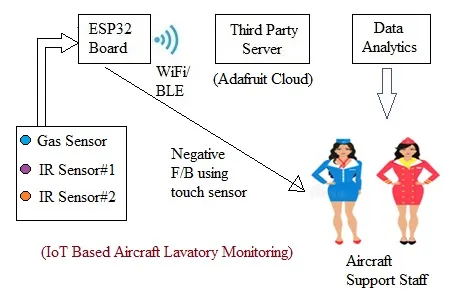
The system utilizes two types of sensors: a gas sensor and two IR sensors.
The gas sensor (e.g., MQ-05) measures the methane level within the lavatory compartment. A threshold methane level, indicative of a clean lavatory, serves as a reference point.
Of the two IR sensors, IR sensor #1 is used for a positive feedback by the passenger. IR sensor #2 is used for negative feedback by the passenger. These IR sensors function as touch sensors in this application.
The sensors are connected to a NodeMCU (ESP32) board, which incorporates Wi-Fi and BLE (Bluetooth) functionalities. The collected sensor data is rapidly uploaded to Adafruit cloud storage before take-off and after landing.
By comparing the real-time sensor data with the methane level threshold, the aircraft support staff is alerted when cleaning is required. An alert is triggered when the real-time methane level exceeds the threshold value. Furthermore, an alert is also triggered when a passenger provides negative feedback by pressing the touch button associated with IR sensor #2.
During flight, achieving connectivity with the Adafruit cloud is not always possible. In these instances, the ESP32 directly communicates with the mobile phone of the aircraft support team using Wi-Fi or Bluetooth frequencies.
Benefits or Advantages of a Smart Lavatory System
Here are the key benefits and advantages of an IoT-based Smart Lavatory system:
Time Savings: It saves time for aircraft maintenance staff, allowing them to attend to a greater number of aircraft lavatories for cleaning.
Passenger Comfort: Passengers experience improved comfort as they have access to a clean lavatory most of the time.
Crew Convenience: Crew members can focus on other services within the cabin.
Cost-Effective: The system is inexpensive to implement and deploy.
Low Maintenance: It requires minimal maintenance once installed.
Continue Learning IoT Basics, Architecture & Tutorials
- IoT Tutorial: Basics, Architecture & Protocol Stack
- Understanding IoT Architecture: Levels 1 to 5
- IoT Stack vs Web Stack
- Advantages, Disadvantages, and Applications of IoT
- Ambient IoT : Advantages & Disadvantages of A-IoT
- Physical Layer Security for IoT Networks in 6G
- IoT Wireless Technologies and Standards
Hardware: IoT Sensors, Actuators & SoCs
- Understanding IoT Sensors
- Understanding IoT System-on-Chip (SoC) - RS9113
- Classification of IoT Devices
- Actuator Types: IoT Guide
- Soft Actuators in IoT
- IoT Antenna Types
Real-World IoT Applications & Systems
- Top 10 Applications of IoT
- IoT Based Smart City Architecture
- IoT Based Healthcare System Architecture
- IoT Weather Monitoring System Architecture
- IoT Smart Retail System Architecture
- IoT Air Pollution Monitoring System Architecture
- IoT Based Intelligent Traffic System
- IoT in Manufacturing
- Satellite IoT Network Architecture
- Cellular IoT Overview