
IoT Smart Retail System Architecture
Advertisement
This page delves into the architecture of an IoT (Internet of Things) based Smart Retail System designed for modern businesses. It highlights the advantages and benefits of implementing such a system.
Introduction
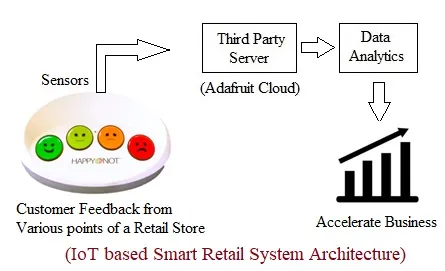
The convergence of IoT sensors, cloud storage servers, and sophisticated data analytics tools has paved the way for the development of intelligent retail outlets. These systems not only contribute to building a smarter retail infrastructure but also foster stronger customer relationships. The core focus lies on gathering real-time feedback from customers and leveraging data analytics to improve customer retention.
Furthermore, a dedicated mobile and web app empowers customers with valuable information about the locations or racks of products and consumable items within the retail store. This comprehensive feedback system ultimately accelerates business earnings.
Key Features and Functionalities
-
Customer Feedback Mechanism: The system incorporates a feedback mechanism where customers can express their experience through options like “Happy,” “Okay,” “Unhappy,” and “Terrible.” These buttons are strategically placed at various locations within the retail store, such as:
- Exit door
- Billing counter
- Item Racks
- Parking exit
- And more…
-
Immediate Attention to Dissatisfied Customers: Customers who select “Unhappy” or “Terrible” receive immediate attention. This proactive approach significantly increases customer satisfaction and offers numerous benefits to business establishments.
-
Comprehensive IoT Integration: Beyond customer feedback, the smart retail system integrates various IoT-driven functionalities, including:
- Surveillance systems
- Fire and smoke alert systems
- Energy management
- Air conditioning and lighting control
-
Smart Infrastructure: The smart retail system also encompasses smart parking solutions, smart cleanliness systems, and smart washrooms, creating a holistic and efficient environment.
Benefits or Advantages of IoT based Smart Retail System
Here are the key advantages of implementing an IoT-based Smart Retail System:
- Economical: The system is highly cost-effective due to the affordability of sensors and other IoT components.
- Efficient: Direct customer feedback collection ensures a highly efficient system.
- Data Analytics Driven: The system leverages the power of data analytics tools and machine learning techniques to effectively analyze collected data. This analysis provides valuable insights for future improvements and changes within the retail store.
- Smarter Retail: IoT (Internet of Things) concepts and architecture contribute to making retail operations increasingly smarter and more streamlined.
- Increased Revenue: The system directly contributes to increasing business revenue.
- Customer Acquisition and Retention: It attracts new customers while simultaneously maintaining and strengthening relationships with existing customers.
Continue Learning IoT Basics, Architecture & Tutorials
- IoT Tutorial: Basics, Architecture & Protocol Stack
- Understanding IoT Architecture: Levels 1 to 5
- IoT Stack vs Web Stack
- Advantages, Disadvantages, and Applications of IoT
- Ambient IoT : Advantages & Disadvantages of A-IoT
- Physical Layer Security for IoT Networks in 6G
- IoT Wireless Technologies and Standards
Hardware: IoT Sensors, Actuators & SoCs
- Understanding IoT Sensors
- Understanding IoT System-on-Chip (SoC) - RS9113
- Classification of IoT Devices
- Actuator Types: IoT Guide
- Soft Actuators in IoT
- IoT Antenna Types
Real-World IoT Applications & Systems
- Top 10 Applications of IoT
- IoT Based Smart City Architecture
- IoT Based Healthcare System Architecture
- IoT Weather Monitoring System Architecture
- IoT Air Pollution Monitoring System Architecture
- IoT Based Intelligent Traffic System
- IoT in Manufacturing
- Smart Lavatory IoT: Aircraft Cleanliness Monitoring
- Satellite IoT Network Architecture
- Cellular IoT Overview