
Slot Antenna Basics and Impedance Explained
Advertisement
This page covers the basics of slot antennas, including their key features and an explanation of the impedance equation.
Definition: A slot antenna is formed by creating a slot in a metallic surface. It essentially consists of an opening, either in a conducting sheet of metal or in the walls of a waveguide.
This type of antenna is typically excited using a coaxial cable or a waveguide with appropriate coupling.
Key Features of Slot Antenna
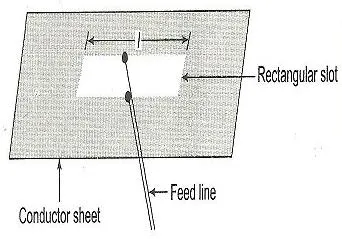
Figure 1: Rectangular Slot Antenna
Figure 1 illustrates a rectangular slot antenna. This type usually features a slot with a length equal to λ/2 and a width significantly smaller than λ/2.
Excitation is commonly achieved using a coaxial cable at a distance of approximately 0.05λ from one end of the slot, as shown in the figure.
Here are some key features of slot antennas:
- The slot can be circular, rectangular, or any other shape and size.
- Slots are omni-directional and radiate from both sides.
- Arrays of slots are used to achieve higher gain and directivity.
- The electric field within the slot resembles a sinusoidal waveform.
Slot Antenna Impedance Equation
The impedance of a slot antenna can be calculated using the following equation:
Zs = [ ηo2 / (4 * Zd) ]
Where:
ηo = 120*π Ohm
Zd = Impedance of the complementary dipole = Rd + j*Xd
- Rd = Real Part
- Xd = Reactive Part
Explore Different Types of Antennas
-
Check-out: Guide to List of Antenna Types >>