
Microstrip Resonator Basics and Types
Advertisement
This article delves into the world of microstrip resonators, covering their fundamentals and various types. We’ll explore open-end resonators, stub resonators, ring resonators, and dielectric resonators.
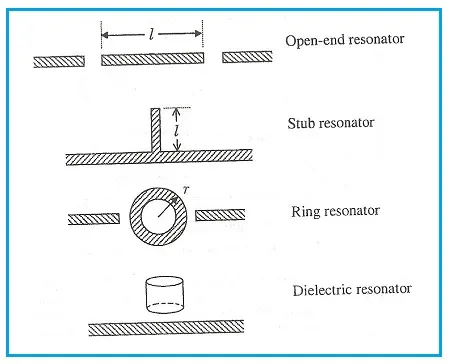
Figure 1 illustrates different kinds of microstrip resonators. As we know, boundary conditions dictate that circuits resonate at specific frequencies.
Open-end resonators and stub resonators exhibit a voltage wave maximum at their open edges. Consequently, resonance occurs for an open-end resonator when the following condition is met:
l = n *(1/2)*λg , where n = 1, 2, 3…
For an open stub resonator, resonance is achieved when:
l = n *(1/4) * λg , where n = 1, 2, 3…
For a ring resonator, the condition for resonance is:
2 * π * r = n * λg , where n = 1, 2, 3…
The resonant frequencies can be determined using the following equation:
One key application of resonators is in the design of filters.
There are four primary types of filters:
- LPF (Low Pass Filter)
- HPF (High Pass Filter)
- BPF (Band Pass Filter)
- BSF (Band Stop Filter)
Continue Learning Resonators & Cavities, Oscillators
- Resonator Types : Coaxial, Dielectric, Crystal, Ceramic, SAW & YIG
- Dielectric Resonator Oscillator
- Cavity Resonators: Basics and Function
- SAW Resonator: 1-Port vs 2-Port
- Oscillator Types
Continue Learning Oscillator Fundamentals & Types
- Oscillator Types
- Voltage Controlled Oscillators (VCOs)
- NE 566 VCO and its application in PLL Design
- Numerically Controlled Oscillator (NCO) and its use in DDS Design
- Understanding YIG Oscillators
- Backward Wave Oscillators (BWO): Advantages & Disadvantages
- OCXO SC Cut Crystal Oscillator: Advantages & Disadvantages
- Understanding Oven-Controlled Crystal Oscillators (OCXO)