
LDACS2 Frame Structure for Aeronautical Communication
By RF Wireless Expert Team
Advertisement
This page explains the LDACS2 frame structure used for communication between Aircraft Stations (ASs) and Ground Stations (GSs). LDACS2 is an aeronautical communication system operating in the L band and utilizes a Time Division Duplex (TDD) structure.
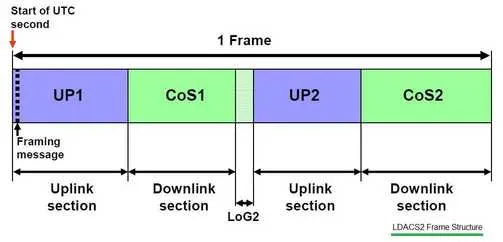 LDACS2 frame structure
The figure above illustrates the TDD LDACS2 frame structure. A frame consists of UP1, UP2, CoS1, CoS2, and LoG2.
- UP1 and UP2: These are dedicated exclusively for Ground Station transmissions.
- CoS1 and CoS2: These are dedicated exclusively for mobile Aircraft Transmissions.
- LoG2: This is used for channel entry purposes.
- CoS1: This is used to carry RTS (Request to Send), ACK (Acknowledgement), or Keep-Alive type frames.
- CoS2: (Content about CoS2 seems incomplete in the original article. Further clarification needed.)
Continue Learning LDACS Frame Structure & Physical Layer & Air Traffic Management
- Air Traffic Management & LDACS Overview
- LDACS1 Frame Structure
- LDACS1 Physical Layer
- LDACS2 Physical Layer
- LDACS1 vs LDACS2: Understanding the Differences
Explore Radio Navigation Systems (VOR, DME, TACAN & More)
Deep dives into the radio-based beacons, direction finders, and navigation systems that have guided aircraft for decades.
- ADF (Automatic Direction Finder) Basics
- VOR (VHF Omnidirectional Range) Basics
- DME (Distance Measuring Equipment) Basics
- TACAN (Tactical Air Navigation) System Basics
- VORTAC (VOR + TACAN) Navigation
- DME vs TACAN Air Navigation
- RNAV (Random or Area Navigation)
- LORAN (Long Range Navigation) Basics
- OMEGA Navigation System
- DNS (Doppler Navigation System)
- INS (Inertial Navigation System)
- Dead Reckoning Navigation System Basics
- Dead Reckoning Navigation Method