
IoT Interoperability: A Deep Dive into Challenges and Testing
Advertisement
This article explores the concept of IoT interoperability, covering interoperability tests and the challenges involved in ensuring different IoT devices can work together seamlessly.
Interoperability: The Core Idea
The primary goal of interoperability is to confirm that independent products, all built to the same standard, can function together within a system without encountering problems. Imagine it like this:
- Example 1: A GSM base station made by Ericsson should work flawlessly with a GSM mobile phone from Samsung.
- Example 2: Generally, base stations and mobile devices, even if manufactured by different companies adhering to the same standard (like GSM), should be able to co-exist and operate effectively within a cellular network.
IoT Interoperability: Bridging the Gap Between Different Standards
IoT interoperability takes this idea a step further. It aims to verify that independent products built to different standards can still communicate and operate together in an IoT ecosystem. This is crucial because IoT networks often incorporate devices based on a variety of different standards.
- Example: A Zigbee-based sensor needs to be able to share data and work effectively with a Bluetooth-enabled gateway or a device using 6LoWPAN.
Interoperability tests are essential for a few key reasons:
- Ambiguities and Errors: Standards documents may contain errors or ambiguities. In some cases, the standards themselves might be incompatible.
- Human Interpretation: Developers may make mistakes when coding to a specific standard, or they might interpret the standard differently, leading to implementation variations.
- Network Differences: Networks may use different traffic queuing methods and other technologies that can impact interoperability.
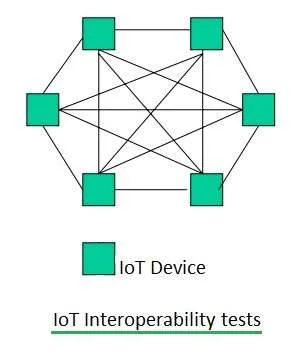
Interoperability Testing: Ensuring Compatibility
Interoperability testing is a method used to determine the extent to which two or more implementations can function together across a range of applications and a specific communication medium.
As illustrated in Figure 1, interoperability testing is most effective when conducted on single pairs of products. When you have N interconnected products, there are (N2 - N) / 2 distinct product pair combinations to test.
IoT Interoperability Challenges
As highlighted in the context of cellular IoT, the Internet of Things typically involves products adhering to diverse standards such as Zigbee, Z-Wave, Bluetooth, GSM, LTE, and more.
The complexity of IoT interoperability testing presents a significant challenge. To ensure the success of IoT projects, test specifications must be meticulously developed and implemented.
Continue Learning IoT Basics, Architecture & Tutorials
- IoT Tutorial: Basics, Architecture & Protocol Stack
- Understanding IoT Architecture: Levels 1 to 5
- IoT Stack vs Web Stack
- Advantages, Disadvantages, and Applications of IoT
- Ambient IoT : Advantages & Disadvantages of A-IoT
- Physical Layer Security for IoT Networks in 6G
- IoT Wireless Technologies and Standards
Hardware: IoT Sensors, Actuators & SoCs
- Understanding IoT Sensors
- Understanding IoT System-on-Chip (SoC) - RS9113
- Classification of IoT Devices
- Actuator Types: IoT Guide
- Soft Actuators in IoT
- IoT Antenna Types
Real-World IoT Applications & Systems
- Top 10 Applications of IoT
- IoT Based Smart City Architecture
- IoT Based Healthcare System Architecture
- IoT Weather Monitoring System Architecture
- IoT Smart Retail System Architecture
- IoT Air Pollution Monitoring System Architecture
- IoT Based Intelligent Traffic System
- IoT Environmental Monitoring System
- IoT Elderly Fall Detection System
- IoT Perishable Food Delivery System
- IoT Radiation Monitoring System
- IoT Smart Driver Assistance System
- IoT Water Quality Monitoring System
- IoT in Manufacturing
- Smart Lavatory IoT: Aircraft Cleanliness Monitoring
- Satellite IoT Network Architecture
- Cellular IoT Overview