
SX1278 LoRa Transceiver IC: Pin Diagram, Circuit & Uses
Advertisement
SX1278 is a sub-GHz RF transceiver IC widely used for long range wireless communication based on LoRa modulation. It operates in the lower RF frequency range and combines a sensitive receiver, power amplifier, frequency synthesizer, and digital modem, making it suitable for IoT nodes, remote monitoring, telemetry, smart agriculture, and other low power long distance applications.
Key features of SX1278
- Frequency Range: 137 MHz to 525 MHz (The SX1278 specifically addresses the lower UHF bands).
- High Sensitivity: Achieves sensitivity down to -148 dBm.
- High Link Budget: 168 dB maximum link budget.
- Integrated Power Amplifiers:
- +20 dBm (100 mW) constant RF output vs. V supply (via dedicated PA_BOOST pin).
- +14 dBm high efficiency PA (via RFO_LF pin).
- Modulation Support: Supports LoRa®, FSK, GFSK, MSK, GMSK, and OOK.
- Low Current Consumption: Low RX current of 9.9 mA, and 200 nA register retention.
- High Blocking Immunity: Bullet-proof front end with IIP3 = -11 dBm.
- Digital Features:
- Built-in bit synchronizer for clock recovery.
- Automatic RF Sense and Channel Activity Detection (CAD) with ultra-fast AFC.
- Packet engine up to 256 bytes with CRC.
- Built-in temperature sensor and low battery indicator.
- Package: QFN 28 Package (6x6 mm).
SX1278 Pin Diagram
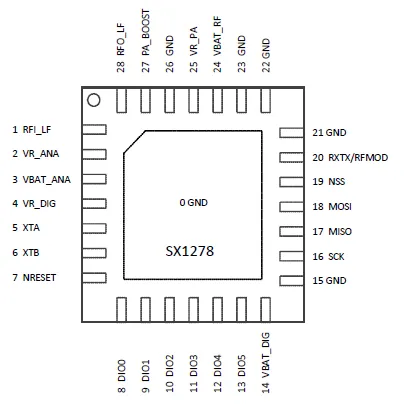
Pin Details (28-pin QFN)
| Pin Number | Name | Type | Description |
|---|---|---|---|
| 0 | GROUND | - | Exposed ground pad |
| 1 | RFI_LF | I | RF input for bands 2 & 3 (Low Frequency) |
| 2 | VR_ANA | - | Regulated supply voltage for analogue circuitry |
| 3 | VBAT_ANA | - | Supply voltage for analogue circuitry |
| 4 | VR_DIG | - | Regulated supply voltage for digital blocks |
| 5 | XTA | I/O | XTAL connection or TCXO input |
| 6 | XTB | I/O | XTAL connection |
| 7 | NRESET | I/O | Reset trigger input (Active Low) |
| 8 | DIO0 | I/O | Digital I/O, software configured (e.g., RxDone/TxDone interrupt) |
| 9 | DIO1/DCLK | I/O | Digital I/O, software configured / Data Clock |
| 10 | DIO2/DATA | I/O | Digital I/O, software configured / Data |
| 11 | DIO3 | I/O | Digital I/O, software configured |
| 12 | DIO4 | I/O | Digital I/O, software configured |
| 13 | DIO5 | I/O | Digital I/O, software configured |
| 14 | VBAT_DIG | - | Supply voltage for digital blocks |
| 15 | GND | - | Ground |
| 16 | SCK | I | SPI Clock input |
| 17 | MISO | O | SPI Data output |
| 18 | MOSI | I | SPI Data input |
| 19 | NSS | I | SPI Chip select input |
| 20 | RXTX/RF_MOD | O | Rx/Tx switch control: high in Tx |
| 21 | GND | - | Not used as RFI_HF on the SX1278 (Connected to Ground) |
| 22 | GND | - | Not used as RFO_HF on the SX1278 (Connected to Ground) |
| 23 | GND | - | Ground |
| 24 | VBAT_RF | - | Supply voltage for RF blocks |
| 25 | VR_PA | - | Regulated supply for the PA |
| 26 | GND | - | Ground |
| 27 | PA_BOOST | O | Optional high-power (+20 dBm) PA output, all frequency bands |
| 28 | RFO_LF | O | RF output for bands 2 & 3 (High-efficiency PA up to +14 dBm) |
Example Use Case : Automated Smart Water Meter (433 MHz Band)
Scenario: A utility company needs to deploy battery powered smart water meters across a sprawling suburban neighborhood. The meters are often located in deep meter pits, basements, or behind thick concrete walls, making traditional FSK wireless signals unreliable over long distances.
Solution : The manufacturer chooses the SX1278 because it specifically targets the lower UHF bands (like the 433 MHz ISM band). They configure the chip to use the proprietary LoRa® modulation instead of standard FSK. The microcontroller interacts with the SX1278 via the standard SPI interface (SCK, MISO, MOSI, NSS). When a packet transmission is complete, the “DIO0” pin triggers an interrupt (configured as “TxDone”), telling the microcontroller it is safe to put the system back into deep sleep.
Applications of SX1278
- Automated Meter Reading (Water, Gas, Electric).
- Home and Building Automation.
- Wireless Alarm and Security Systems.
- Industrial Monitoring and Control.
- Long range Irrigation Systems.
Summary
SX1278 enables long range wireless communication with low power consumption, making it well suited to IoT and remote monitoring applications. Its LoRa based architecture provides useful range and receiver sensitivity for applications such as smart agriculture and telemetry.
Continue Learning LoRaWAN Technology
- LoRa Basics Tutorial
- LoRaWAN Network Architecture
- LoRaWAN Protocol Stack
- LoRaWAN Physical Layer
- LoRaWAN MAC Layer
- LoRa Channel to Frequency Conversion
- LoRaWAN Frequency Bands
- LoRaWAN Classes
- LoRaWAN Interface Types