
VSCP Framework Basics and IoT Operations
By RF Wireless Expert Team
Advertisement
This page covers the basics of the VSCP Framework and describes its working operations within the Internet of Things (IoT).
VSCP stands for Very Simple Control Protocol.
- It functions more as a framework than a protocol.
- VSCP facilitates interaction between devices at the application layer.
- VSCP is compatible with various protocol mechanisms, including: CAN, Ethernet, RS232, TCPIP, Zigbee, Bluetooth, USB, GPRS, etc.
- VSCP employs an event-driven format.
- It supports global identifiers for nodes, allowing a node to be identified regardless of its location worldwide.
- It incorporates a register model to provide a flexible, common interface for node configuration.
- It offers a model for controlling the functionalities of each node.
VSCP Working Operation
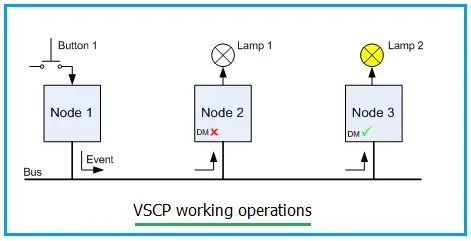
Figure: VSCP Framework
- When an event occurs, it is broadcast to all other nodes on the network.
- Each node then determines whether the received event needs to be processed.
- The final decision is based on the node’s decision matrix. This matrix consists of a number of “if conditions.” The evaluation of these conditions depends on the fields present in the VSCP datagram that is broadcast to the network.
VSCP Reference
Continue Learning Core Networking : TCP, IP & UDP
- OSI vs TCP/IP Models
- Understanding TCP/IP Packet Format
- TCP vs UDP: Key Differences
- TCP vs MPTCP (Multipath TCP)
- IPv4 vs IPv6
- MPLS Label Switching vs IP Packet Switching
- Non-IP Networking: Working, Protocols & Benefits
Continue Learning IoT Basics, Architecture & Tutorials
- IoT Tutorial: Basics, Architecture & Protocol Stack
- Understanding IoT Architecture: Levels 1 to 5
- IoT Stack vs Web Stack
- Advantages, Disadvantages, and Applications of IoT
- Ambient IoT : Advantages & Disadvantages of A-IoT
- Physical Layer Security for IoT Networks in 6G
- IoT Wireless Technologies and Standards