
UWB vs. Bluetooth Keys: Which is Safer?
Advertisement
Introduction : In today’s world of smart devices and connected cars, “digital keys” are fast becoming the norm. It lets us unlock doors or start our vehicle with tap of your smartphone instead of physical key. But not all digital key technologies are created equal. Two leading wireless standards powering digital keys today are Ultra‑Wideband (UWB) and Bluetooth Low Energy (BLE). While both enable keyless entry and convenient access, they differ fundamentally in how they work, how accurate and secure they are and what user experiences they enable.
As more carmakers, smartphone vendors and smart lock manufacturers adopt digital key solutions, understanding the relative strengths and shortcomings of UWB and BLE becomes essential.
As smartphones replace physical key fobs, automakers are engaged in silent battle over wireless protocol that secures car. For years, Bluetooth Low Energy (BLE) was the standard. However due to rising theft rates via “relay attacks”, the industry is shifting towards Ultra-WideBand(UWB).
Bluetooth (BLE) Keys
The bluetooth technology was initially developed for data communication mainly for audio. In key based applications, it relies on RSSI (Received Signal Strength Indicator) based method. Let us understand it’s working.
- The car measures strength of the signal from your phone. When signal is loud enough, it interprets that phone is close. Consecutively it allows to unlock the door.
- When the signal is poor in strength, it interprets that phone is far and does not allow to unlock the door. The door remains locked.
The RSSI based method is fundamentally insecure as some intruders or thieves can use relay device and boosts the signal originated from key fob which is inside your house. After receiving and boosting the signal relay device transmits this fake signal to the car and gain access to it.
 Image Courtesy : QorVo, Inc.
Ultra-Wideband (UWB) Keys
The UWB was introduced into digital key 3.0 specification specifically to fix the security loopholes observed in the Bluetooth based key technology. Let us understand how it works.
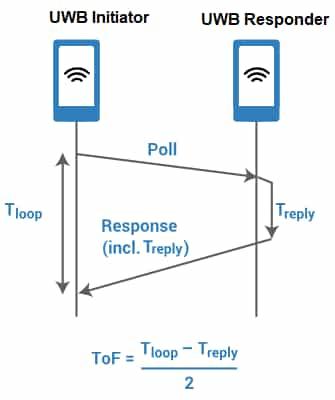
- Instead of measuring signal strength, UWB measures time. It uses time of flight measurement technique as shown in figure-2.
- The car sends nanosecond pulse to the phone, and the phone replies. The car calculates exactly how long the round trip time taken by the pulse.
- In UWB based key, if thief tries to relay the signal by boosting it, it will incur extra distance which consecutively increases delay in microseconds. UWB system rejects this delay and rejects unlock request.
UWB based digital key is accurate to within 10 centimeters. This allows car to make smart decisions such as unlock door, start the engine etc.
Difference between Bluetooth Keys Vs. UWB Key
As shown in the figure-1, UWB offers location detection accuracy of less than 10 cm which is better than BLE (Bluetooth Low Energy) of about 1 meter. Moreover UWB requires less number of anchors in the same size factory compared to BLE. Let us compare UWB vs Bluetooth Low Energy (BLE) with respect to other parameters in the table below.
| Feature | Bluetooth Key | UWB Key |
|---|---|---|
| Ranging Method | RSSI based | ToF (Time of Flight) based |
| Security Risk | High, susceptible to relay attack | Low, prevents relaying |
| Accuracy | Low, estimates within meters | High, precision within centimeters |
| User Experience | Inconsistent, Often requires taking phone out | Passive, Phone Stays in bag/pocket |
| Interference | High, blocked by body/metal | Low (Penetrates obstacles easily) |
| Battery Impact | Very low | Low (Optimized via pulse mode) |
| Implementation | Cheap/standard | Requires UWB hardware i.e. anchors |
Summary
If you prioritize precise proximity detection, robust protection against relay or spoofing attacks and reliable hands free unlocking based on your exact location, UWB stands out as the superior choice. Its centimeter level ranging precision, time of flight (ToF) based authentication and low susceptibility to interference give UWB a clear edge for high security digital keys.
On the other hand, BLE based digital keys remain an attractive option for those seeking wide compatibility, cost efficiency and longer battery life; especially in scenarios where meter level proximity detection is sufficient and extreme accuracy is not required.
Tags
Advertisement


