
UWB Parking Payment: Working, Benefits & Comparison with RFID
Advertisement
Introduction : Traditional parking methods are described as inconvenient and inefficient due to following reasons.
- Physical hassles like fumbling for tickets or struggling to reach payment terminals.
- Long queues at exit points.
- Limitations in existing technologies (e.g., RFID accuracy issues, license plate recognition requiring heavy background support and NFC requiring a physical “tap”).
In this application note, we will compare RFID and UWB technologies used as parking payment systems. UWB parking payment is redefining how vehicles interact with parking infrastructure by enabling fully automated, location aware and secure transactions. Unlike traditional RFID based parking systems that rely on fixed readers and limited range accuracy, Ultra-Wideband (UWB) uses precise distance measurement to identify vehicle presence, parking duration and exit events in real time. Let us understand working of RFID and UWB based parking payment systems before we summarize their differences.
RFID based parking system
The core concept in RFID based payment system is wireless handshake between your car and toll booth. Instead of stopping to hand over cash, radio waves are used to identify your vehicle and deduct money from prepaid account automatically when your car is moving. Following are the RFID components and their functions which form RFID system.
- RFID Tag : It is a small device with microchip containing unique ID and small antenna. The RFID tags are attached to windshield like E-ZPass or FASTag.
- RFID Reader : It is mounted on the overhead gantry or side of toll lane. It continuously emits radio waves to detect incoming RFID tags.
- Backend database : A central computer system that links your tag’s unique ID to your personal bank account or digital wallet.
- Lane Controller : The computer at the toll booth which controls traffic light and physical barrier. This barrier opens once payment is confirmed.
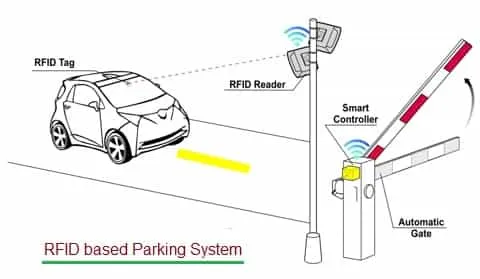
Let us understand how RFID system works.
- As your vehicle attached with tag (either passive or active) approaches the toll lane, it enters the Electromagnetic Field created by the RFID Reader. Passive tag does not have battery. The radio waves from reader power up this passive tag type. The active tag contains battery and may be sleeping to save power and woke up upon reception of reader’s signal.
- Once activated, the Tag transmits its Unique ID code back to the Reader via radio waves. This happens in milliseconds.
- The Reader sends this ID code to the Backend Database via a secure network. The system checks the same.
- If the checks pass, the system automatically deducts the toll amount from your prepaid balance or linked bank account.
- The central system sends a “Success” signal back to the Lane Controller. The traffic light turns green, and the boom barrier lifts to let you pass.
How UWB Parking Actually Works
Unlike Bluetooth or standard RFID, UWB is a short range wireless communication system. It operates through radio waves at very high frequencies. It is incredibly precise at measuring location and distance. Think of it as “digital radar” that is already built into many modern smartphones, wearables and newer vehicles.
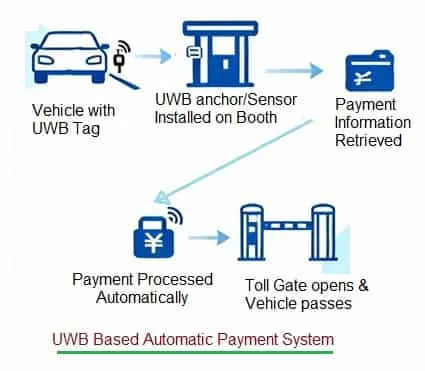
UWB technology turns “contactless” experience into “touchless” one. There is no need to open an app or roll down the window. Let us understand how UWB works in parking payment use case.
- As car approaches the garage, the parking controller detects your UWB enabled phone or smartwatch.
- The system verifies your device. If you have multiple people in the car with phones, the system is smart enough to identify the driver’s preferred payment device.
- The gate opens automatically. No stopping to grab a ticket. The system logs your entry time securely.
- When you drive out, the system calculates your duration based on your unique device ID.
- The gate opens instantly, and the payment is processed in the background.
Key Advantages of UWB
Following are some of the benefits of UWB over existing solutions available in parking payment use case.
- Truly Tap-Free : Payments happen automatically when the device is within range; no physical action is required.
- High Level Security : UWB uses Time of Flight (ToF) measurements and Scrambled Time Sequences (STS) to prevent hacking attempts like relay or man-in-middle attacks. It can also integrate with hardware based secure elements (similar to smartcards).
- Eliminates Friction : Removes the struggle of reaching elements as it allows monitoring via dashboard or phone.
- Optimized traffic flow : Reduces congestion at entry and exit points.
Difference between UWB Vs. RFID
Let us compare both the RFID and UWB technologies with respect to various issues and scenarios observed in wireless parking.
- Precision & Accuracy :
- RFID has limitations in accuracy and insufficient coverage. Moreover it relies on signal strength to detect a tag which leads to false positives or failure to read if angle isn’t right.
- UWB uses Time of Flight (ToF) measurements. Hence it calculates exact distance between gate and car. This allows system to know exactly where the car is, ensuring the gate opens only when the vehicle is in the precise entry zone.
- Security & Anti-Theft :
- RFID is susceptible to relay attacks (i.e. thief amplifies signal to trick the reader) and man-in-the-middle attacks.
- UWB uses Scrambled Time Sequences (STS) and cryptographic technology. Moreover it measures physical time which is nearly impossible to hack via relay attack. If a hacker tries to amplify the signal from a distance, the “time delay” will reveal the fraud and the transaction will be rejected.
Let us summarize comparison between RFID and UWB with respect to various aspects.
| Feature | RFID (Traditional Toll Tags) | UWB (Latest Parking System) |
|---|---|---|
| Primary technology | Uses radio signal strength (RSSI) to detect presence | Uses Time of Flight (ToF) to measure precise physical distance |
| Accuracy | Limited, Prone to blind spots or insufficient RF coverage; may struggle with precise lane detection | High precision, accurate down to centimeters; ensures the correct vehicle is triggered. |
| Security | Vulnerable. Susceptible to cloning, relay attcks, and signal amplification hacks | High Security. Uses Scrambled Time Sequences (STS) and cryptography to prevent relay/man-in-the-middle attacks. |
| User Hardware | Requires a dedicated physical tag or sticker on the car windshield | Uses existing smartphones or wearables (i.e. No extra hardware is needed) |
| Multi-Device Logic | Simple blind reading; reads whatever tag it finds first | Smart verification; Can detect multiple devices in one car and allow user to select the preferred payment method. |
| Interaction Style | Contactless (usually automatic), but requires user to own/install the specific tag. | Touchless/Invisible; Automatic interaction using phone in your pocket |
Summary: When comparing UWB parking payment with RFID, UWB clearly offers superior accuracy, security and user experience. While RFID remains suitable for basic access control, it lacks the precise ranging and anti-fraud capabilities required for modern, automated parking environments. UWB enables seamless, hands free payments, reduces infrastructure dependency and supports scalable smart parking ecosystems. As demand grows for intelligent mobility and frictionless urban services, UWB stands out as the preferred technology for next generation parking payment solutions.
Explore More UWB Use Cases
- UWB based Child Presence Detection
- UWB Vs NFC : Secure Payment Use Case
- UWB based digital key for theft prevention
- UWB vs GPS for Warehouse Asset Tracking
- Digital Twin Using UWB for Factory Use Case