
UWB vs. NFC: Secure Contactless Payment Comparison
Advertisement
Introduction : For the last decade, tap has been universal gesture of modern commerce. Whether it’s boarding a train or buying a coffee, NFC has liberated us from swiping magnetic strips. These “tap based payments” are getting outdated slowly and nw contender has entered known as UWB. The UWB promises to shift industry from “Contactless” to truly “Touchless”.
Contactless payments are evolving rapidly, and Ultra-Wideband (UWB) and Near Field Communication (NFC) are two leading technologies enabling secure, seamless transactions. While NFC is widely adopted in smartphones and payment cards, UWB introduces precise distance and location awareness, opening new possibilities for fraud resistant payments. Understanding how UWB and NFC work, and how they differ in terms of security, accuracy and user experience, is essential for businesses and developers building next generation payment solutions.
Understanding NFC (Near Field Communication)
NFC has been cornerstone of secure transactions for years. If you use Apple Pay, Google Wallet or modern credit card, you are using NFC. Let us understand how NFC works.
- It uses frequency of about 13.56 MHz.
- It relies on inductive coupling which allows data exchange between a card/phone and a reader.
- Range is extremely short i.e. typically less than 10 centimeters (~ 4 inches).
- User requires to physically pull device out and hover it over a specific spot. It is contactless, but it still requires close proximity.
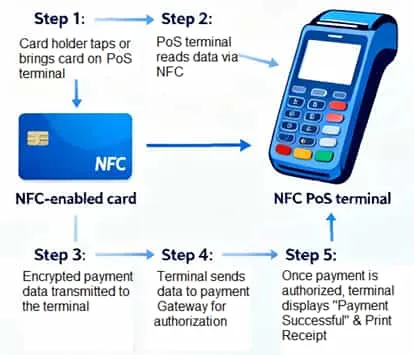
Example Use Case: For paying through card swiping machine or Point of Sale (POS) terminal using credit/debit card which are both NFC enabled. The figure-1 depicts all the steps involved in NFC based payment using PoS terminal.
Understanding UWB (Ultra-Wideband)
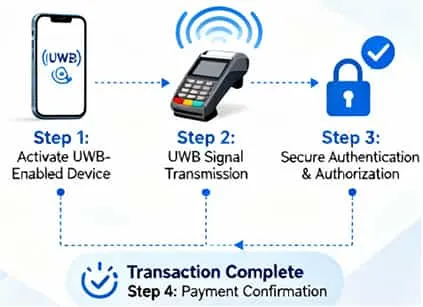
UWB was not originally designed for payments. It was developed for radar. Now, it is finding its way into consumer electronics to revolutionize how we interact with the world. There is report of over 1.5 billion devices shipped by 2023. Let us understand how UWB works in secured payment use case at Point of Sale (POS) terminal.
-
UWB operates in 3.1 to 10.6 GHz band with channels 500 MHz wide.
-
Instead of magnetic fields, UWB uses Time of Flight (ToF).
-
There are two modes of opetations in UWB.
- One mode is called ranging and it uses two active UWB chips at tag and anchor. In this case, one active device transmits a pulse and the other device responds it after some delay. The transmitting UWB device calculates time of flight to determine position or location.
- The other mode is called sensing. It uses one active UWB chip. It sends impulse based radio waves and measures exactly how long it will take to bounce back.
- UWB helps to determine exact location and movement direction within centimeters.
Example Use Case: UWB is “Touchless.” It allows for hands free interactions. Imagine walking through subway gate without breaking stride or paying for groceries while your phone stays in your pocket.
Difference between UWB and NFC
Let us compare both the NFC and UWB technologies with respect to various issues and scenarios.
- Security : The “relay attack” problem is a biggest concern in wireless payments. NFC is usually secure because it works only at short ranges. Bluetooth and Wi-Fi have longer ranges but are vulnerable to relay attacks. This is where hacker intercepts signal between your phone and the terminal to approve transaction you didn’t authorize.
- UWB Solution : As UWB uses “time of flight” measurement, it calculates precise physical distance between devices. If a hacker tries to relay the signal from a distance, UWB detects the delay and rejects the transaction.
- User experience : In NFC, user need to stop, locate the reader and hover. It is a stop-and-go experience. In UWB, you can pay by simply walking past a terminal.
- Real World Example Use Case : ING Bank piloted a solution where users could transfer money simply by pointing their phones at each other.
Let us summarize comparison between NFC and UWB with respect to technical and functional aspects.
| Feature | NFC (Near Field Communication) | UWB (Ultra-Wideband) |
|---|---|---|
| Core Technology | Short Range wireless communication based on inductive coupling | Impulse based radio technology using Time of Flight (ToF) Measurements |
| Frequency | Operates at 13.56 MHz | Operates on broad spectrum from 3.1 GHz to 10.6 GHz using 500 MHz wide channels. |
| Range & Detection | Very short range, works when both transmitter and receiver are within a few centimeters (up to 10 cm) | Short range but capable of precise positioning and distance measurement, originally developed for radar |
| Payment Style | Contactless, requires a deliberate action, users must bring the device closer to the terminal i.e. tap or hover | Touchless/Hands-free, Enables payments by walking past a terminal or pointing a device; No physical “Tap” required. |
| Security Focus | Generally secure due to short range of operation, but standard proximity checks can be theoretically vulnerable is range is extended. | Anti-Relay Attack, Uses precise distance calculations and scrambled time sequences (STS) to prevent hackers from intercepting/spoofing signals. |
| User experience | Stop-and-Go; The user must pause to interact with the NFC reader | Seamless Flow; Authentication happens based on proximity and movement direction e.g. keeping the phone in a pocket |
| Primary use case | Payments, Access Control, Transport Ticketing, ID documents | Precision location tracking, hands-free access (cars/doors), P2P payments (Pointing to transfer), Tap-free transport |
Summary : Both UWB and NFC play important roles in contactless payment ecosystems, but they serve different use cases. NFC remains ideal for short range, tap based payments with proven reliability, while UWB offers enhanced security through precise ranging and spatial awareness. As digital payments continue to advance, UWB is expected to complement NFC by enabling more secure, context aware and hands free payment experiences.
Explore More UWB Use Cases
- UWB based Automatic Parking System
- UWB based Child Presence Detection
- UWB based digital key for theft prevention
- UWB vs GPS for Warehouse Asset Tracking
- Digital Twin Using UWB for Factory Use Case