
What is RFoG : Radio Frequency over Glass Architecture
Advertisement
RFoG (Radio Frequency over Glass) is a specialized broadband architecture that transmits traditional RF cable television and DOCSIS signals over a modern fiber optic network. It allows operators to deliver high speed Fiber to the Home (FTTH) services while utilizing existing customer premises equipment (CPE). This architecture effectively bridges the gap between legacy coaxial cable networks and future-proof optical fiber network deployments.
Introduction
RFoG (Radio Frequency over Glass) combines the benefits of RF and fiber optics for seamless communication. This innovative architecture enables RF signals to travel over optical networks, enhancing efficiency and reducing interference. In this guide, we dive into the RFoG architecture, its working, and its applications in modern communication.
The RFoG technology replaces the coaxial part of an HFC (Hybrid Fiber Coaxial) network with a single mono-mode fiber. It is known as PON (Passive Optical Network).
SCTE (Society of Cable Telecommunications Engineers) has published specifications for RF over glass fiber in the document ANSI/SCTE 174 2010. RFoG has advantages of transmitting RF over glass fiber due to its enormous bandwidth and less interference compared to radio frequency transmission. Moreover, it travels a distance of about 50 Km.
Key features of RFoG technology
This has become essential due to the increasing demand for support for a higher number of subscribers in a single cellular base station. This RFoG technology extends the range of glass fiber based networks to buildings and living rooms. The following are the silent features of RFoG technology.
- Uses existing fiber optic network to couple RF (with AM/FM modulation).
- It uses 1550 nm for upstream transmission and 1310 nm or 1610 nm for downstream transmission.
- Provides downstream bandwidth up to 1 GHz.
- Enables FTTH (Fiber to the Home) and FTTB (Fiber to the Building) networks using the DOCSIS standard.
- Seamlessly integrated into existing HFC network.
- RFoG transmitter and receiver modules provide a distance coverage of about 50 Km.
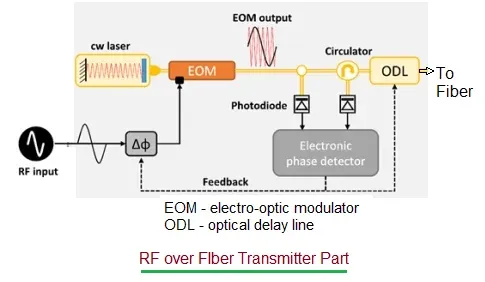
The figure-1 depicts RF over fiber transmitter block diagram.
RFoG Architecture | RF over Glass Architecture
Figure-2 depicts RFoG architecture. As shown, the architecture consists of an optical Hub, ODN (Optical Distribution Network) and subscriber home premises. The main part in RFoG architecture is ONU (Optical Network Unit).
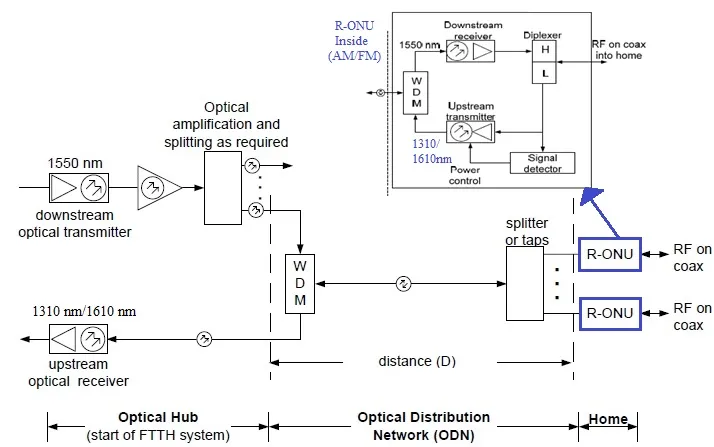
The ONU is located between the RF and optical domain. Depending upon AM or FM, the RF modulation part will vary. Like RF, the optical system uses one wavelength for transmission (1550 nm) and the other wavelength for reception (1310 nm /1610 nm).
Like a diplexer is used to separate/combine transmit and receive bands in the RF, the optical system uses WDM (Wavelength Division MUX/DEMUX) for optical signals. This is shown in the figure above.
Summary
The RFoG architecture empowers cable operators to transition to highly scalable fiber networks without forcing immediate, costly hardware upgrades for consumers. It is the ultimate hybrid bridge for delivering next-generation bandwidth while maintaining backward compatibility with DOCSIS infrastructure.