
What is 60 GHz Frequency : Advantages and Disadvantages
By RF Wireless Expert Team
Advertisement
The 60 GHz frequency band is part of the millimeter wave spectrum used for high capacity wireless communication systems. Advantages include large available bandwidth and reduced interference, while disadvantages include atmospheric attenuation and limited coverage range. It is widely used in wireless backhaul, WiGig networks, and advanced communication applications.
Key features of 60 GHz
- It falls under the millimeter wave band (30 GHz to 300 GHz).
- It’s one of the unlicensed frequencies widely used in the band from 57 to 66 GHz.
- It’s part of the V Band Frequency range.
- It has a shorter wavelength of 0.5 centimeters.
- It’s commonly used for low-power and short-distance communication.
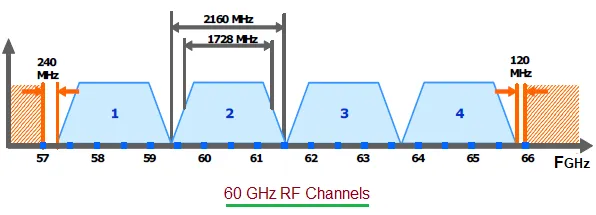
- Figure 1 depicts four popular channels, each with about 2 GHz of bandwidth, spanning from 57 to 66 GHz.
- It’s used in technologies like WPAN (IEEE 802.15.3-2003), WLAN (WiGig as per 802.11ad), and WirelessHD.
Benefits or Advantages of 60 GHz Frequency
- Sufficient Bandwidth: It offers a substantial bandwidth of 9 GHz in total. Different countries use different bands within this range. For example, the US and Canada utilize a 7 GHz band from 57.05 GHz to 64.00 GHz.
- Higher EIRP: The millimeter wave band allows for the use of higher EIRP (Effective Isotropic Radiated Power), which can be around +40 dBm in the USA and Canada.
- Reduced Interference: As it uses low power for transmission, there’s a lower likelihood of interference. This increases frequency reuse density.
- Small Antenna Size: Small-sized antennas or apertures are possible to realize at these frequencies. This leads to compact overall system packaging and can deliver high radiation gains.
- Enhanced Security: Due to the low power and short-distance communication, it provides highly secured communication. It reduces the risk of theft by eavesdropping on nearby transmissions.
- Standardization: It has been standardized under IEEE 802.15.3c for WPAN applications, 802.11ad for WLAN applications, WirelessHD, and 5G NR (New Radio) as per 3GPP release-15. WirelessHD technology offers higher bandwidth (10 to 28 Gbps) with a coverage range of about 10 meters.
Drawbacks or Disadvantages of 60 GHz Frequency
- Limited Range: 60GHz wireless systems offer a shorter range due to the path loss encountered at this frequency. The free space path loss over a length of 1 meter at 60 GHz is about 68 dB.
- Poor Penetration: 60GHz frequency signals cannot easily penetrate through walls.
- RF Absorption: This frequency experiences a substantial RF absorption peak due to the resonance of oxygen molecules. This is significant at ranges greater than 100 meters. However, low-range communication will not be significantly affected by this issue.
Summary
The 60 GHz frequency band supports high speed wireless communications with large bandwidth availability. Advantages include fast data transfer, while disadvantages include short range performance and signal attenuation.