
What is 1-Wire Interface : 5 advantages and disadvantages
Advertisement
The 1-Wire interface protocol is a low cost serial communication standard that allows data and power transmission over a single wire plus ground. Advantages include simple wiring, low cost and device addressing, while disadvantages include lower speed, limited distance and susceptibility to noise. It is commonly used in sensors and embedded systems.
Key Features
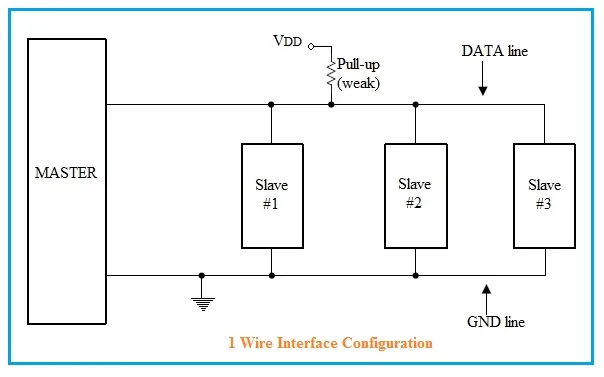
- It supports data exchange between a master device and multiple slave devices.
- Unlike many other communication protocols, 1-Wire doesn’t use a separate clock signal.
- Instead, it relies on an internal clock. It typically uses two wires in total: one for data and one for ground (GND).
- Communication is half-duplex, meaning data can only be transmitted in one direction at a time.
- The protocol uses a 64-bit device addressing scheme, allowing for a large number of uniquely identifiable devices.
- Multiple slaves can be connected in a multi-drop configuration (all connected to the same wire).
- Data rates are relatively low, with 16.3 Kbps in standard mode and 163 Kbps in overdrive mode.
- A key advantage is its low power consumption.
Advantages of 1-Wire Interface
Following are key benefits of 1-Wire interface.
- Multi-drop capability: Multiple slave devices can be accessed using only two wires (data and ground).
- Cost Effective: Fewer wires translate to lower material costs, making it a cheaper solution overall.
- Easy Implementation: The interface is relatively straightforward to implement, simplifying the design process.
- Long Distance Support: 1-Wire can support communication over longer distances, up to approximately 300 meters.
- Unique Device Identification: Each 1-wire device has unique 64 bit ID, which allows easy device addressing in networks.
Disadvantages of the 1-Wire Interface
Following are some of the drawbacks of 1-Wire interface.
- Software Complexity: Implementation requires both hardware and software components. Data synchronization at the receiver needs careful handling in software, which can be complex.
- Distance Limitations: While it supports longer distances than some other protocols, it’s still susceptible to noise and cable capacitance, which can limit the practical usable distance.
- Slow Communication Speed: The data transfer rates are relatively slow compared to other modern communication interfaces such as SPI or I2C.
- Limited Vendor Support: 1-Wire slave devices are primarily manufactured by Dallas Semiconductor (now Maxim Integrated), limiting your vendor choices.
Summary
The 1-Wire protocol enables communication and power delivery through a single data line. Its advantages include simplicity and low cost, while disadvantages include slower data rates and limited communication range. Its unique device identification and low power requirements make it ideal for applications like temperature sensing, authentication and small scale sensor networks.