
Spacecraft Propulsion Systems: Types and Functions
Advertisement
This page describes different types of Spacecraft Propulsion Systems, including their classification and functions.
Definition: Propulsion systems are the mechanisms used to apply forces and torques to a spacecraft in space in order to transfer, position, and orient it.
Functions of Spacecraft Propulsion Systems
As mentioned in the definition, the functions of spacecraft propulsion systems include:
- Transfer: Used for interplanetary travel.
- Position: Used for orbit control.
- Orientation: Used for attitude control.
Characteristics of Spacecraft Propulsion Systems
These characteristics are essential for attitude and orbit operational requirements of the spacecraft or satellite:
- Very high velocity increment capabilities.
- Low thrust levels with lower acceleration levels.
- Continuous operation mode for orbit control.
- Pulsed operation mode for attitude control.
- Predictable, accurate, and repeatable performance.
- Reliable, Leak-free long time operation
- Minimum and predictable thrust exhaust impingement effects
Types of Propulsion Systems | Classification of Propulsion Systems
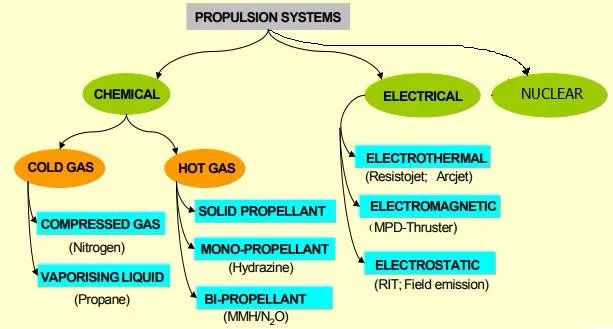
The following are the types of propulsion systems used in a Spacecraft. These types are based on the source of energy used for the ejection of the propellant.
The figure-1 depicts a tree chart of the classifications.
- Chemical Propulsion: This type uses heat energy produced due to a chemical reaction. It produces gases at high temperature and pressure in a combustion chamber. These gases are accelerated through a nozzle device and ejected from the spacecraft system at high exit velocity in order to produce thrust force.
- Electric Propulsion: This type uses electric or electro-magnetic energy to eject matter at a higher velocity in order to produce thrust force.
- Nuclear Propulsion: This type uses energy from a nuclear reactor to heat gases. These gases are accelerated through the nozzle and consecutively ejected from the spacecraft system at a very high exit velocity in order to produce thrust force.
Spacecraft & Space Technology
Resources covering the vehicles that navigate the cosmos, the materials used to build them, and the growing issue of orbital debris.
- Space Tech Hub
- Space Materials: Properties, Types & Applications
- Space Debris and Removal Techniques
- Unmanned Spacecraft: Advantages & Disadvantages
- Spacecraft Thrusters
- Spacecraft Propulsion Systems: Advantages & Disadvantages
- Space-Grade RF Coaxial Components (Vendors)
Continue Learning Satellite Communication Technology
- Satellite Communication Basics Tutorial
- GEO Vs. LEO Vs. MEO Satellite Types
- Apogee and Perigee in Satellite Communication
- Satellite Capacity Allocation Types
- Satellite Frequency Bands
- Satellite Transponder Components & its function
- Satellite Bus vs Payload : Understand functions
- Satellite Ground Station Basics
- Satellite System Security Mechanisms & Standards
- Satellite Parking Lot Concepts and Procedures
- Satellite Launching Procedure and Processes
- Telemetry, Tracking and Command (TTC) in Satellite System