
What is HEO (Highly Elliptical Orbit) : Advantages and Disadvantages
Advertisement
Highly Elliptical Orbit (HEO) is a satellite orbit characterized by a large difference between perigee and apogee distances. It is used to provide extended coverage over high latitude regions where GEO satellites are less effective. Advantages include improved polar coverage, while disadvantages include variable latency and more complex orbital management.
Types of Orbits for Satellite Installation
Different types of Earth orbits offer unique advantages and capabilities:
- LEO (Low Earth Orbit): Commonly used for communication, remote sensing, the International Space Station, and the Hubble Space Telescope.
- MEO (Medium Earth Orbit): Primarily used for navigation systems like GPS.
- GSO (Geosynchronous Orbit) & GEO (Geostationary Orbit): Ideal for telecommunications and Earth observation. GEO is a specific type of GSO.
- Polar Orbit & SSO (Sun-Synchronous Orbit): Within 30 degrees of Earth’s poles. Utilized for reconnaissance, weather tracking, atmospheric measurements, and long-term Earth observation.
- HEO (Highly Elliptical Orbit): Can support applications similar to both LEO and MEO satellites.
Highly Elliptical Orbit (HEO) Characteristics
HEO is an oblong orbit around the Earth, characterized by one end being much closer to Earth than the other. It’s also known as a Molniya orbit.
Characteristics of HEO:
- Altitude: Ranges from approximately 20,000 to 47,000 km.
- Orbital Period: Longer than 24 hours, causing satellites in this orbit to appear retrograde.
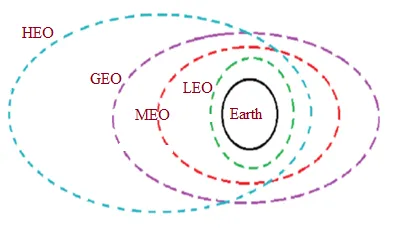
HEO satellites are used for communication, satellite radio, remote sensing, magnetosphere studies, and astronomical observations. Examples include Ellipso, Molniya, Archimedes, and Inmarsat satellites (e.g., GX10A and GX10B).
Advantages of HEO
- Medium Round-Trip Delay: Offers a balance in signal delay.
- Variable Path Loss: Path loss between the satellite and Earth varies significantly depending on the satellite’s position in its orbit (smaller on the closer side, larger on the far side).
- Variable Coverage Area: Coverage area varies with the satellite’s position (smaller on the closer side, larger on the far side).
- Reduced Atmospheric Drag: HEO satellites experience less atmospheric drag compared to LEO and MEO satellites.
- Service to High-Latitude Regions: Can provide services to high-latitude regions that geostationary orbits cannot reach.
- Longer Dwell Time: Offers extended dwell time over specific areas of the sky.
Disadvantages of HEO
- Complex Satellite Systems: HEO satellite systems are more complex than those in other orbits.
- High Propagation Delay: Can result in the highest propagation delay on one side of the Earth.
- Selective Area Coverage: Offers coverage to selected areas.
- Apparent Opposite Direction: Satellites in HEO appear to move in the opposite direction.
- Higher Cost: Manufacturing and launching HEO satellites is typically more expensive.
Summary
HEO satellites offer enhanced communication coverage for northern and southern latitudes. Advantages include extended regional visibility, while disadvantages include orbital complexity and varying signal delays.
Continue Learning Satellite Communication Technology
- Satellite Communication Basics Tutorial
- GEO Vs. LEO Vs. MEO Satellite Types
- Apogee and Perigee in Satellite Communication
- Satellite Capacity Allocation Types
- Satellite Frequency Bands
- Satellite Transponder Components & its function
- Satellite Bus vs Payload : Understand functions
- Satellite Ground Station Basics
- Satellite System Security Mechanisms & Standards
- Satellite Parking Lot Concepts and Procedures
- Satellite Launching Procedure and Processes
- Telemetry, Tracking and Command (TTC) in Satellite System