
What is Sound Sensor: 5 Advantages and Disadvantages
Advertisement
A sound sensor is an electronic device that detects acoustic signals and converts sound intensity into electrical signals for monitoring or control applications. Its advantages include simple operation, real-time sound detection, and low power consumption, while its disadvantages include sensitivity to background noise, limited detection range, and calibration requirements.
Types of Sound Sensor
A sound sensor converts air pressure variations (sound) into electrical current.
These sensors are dynamic, using an induction coil placed in the magnetic field (H) of a permanent magnet attached to a diaphragm. Sound sensors are commonly known as microphones. common types of sound sensors are as follows.
- Dynamic Microphone (Uses Electromagnetic Induction)
- Carbon Microphone
- Ribbon Microphone
- Condenser Microphone (Uses capacitance change)
- Piezoelectric microphone (Uses piezoelectricity)
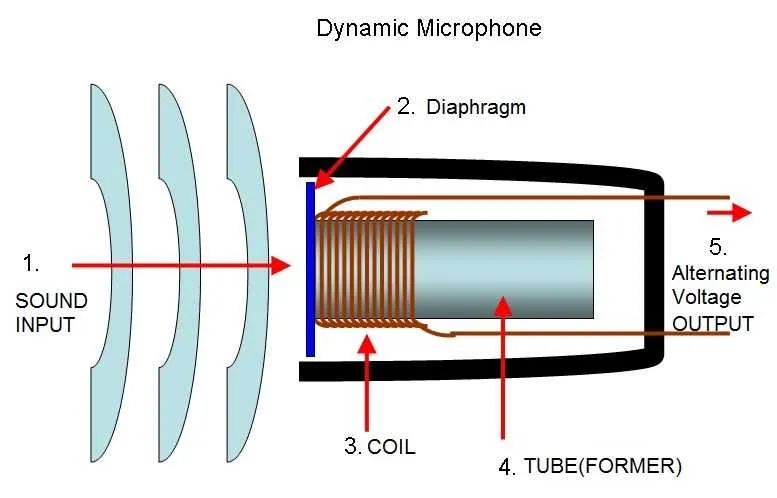
Sound sensors are typically connected to a pre-amplifier before the sound is recorded, transmitted, or played through a loudspeaker. They are used in homes, offices, and outdoor applications. Figure 1 (above) shows a dynamic microphone.
Advantages of Sound Sensors
- Security Systems: Sound sensors are often used in security systems.
- Speech Recognition: They work with speech recognition software to convert speech to text, which is faster than typing and helpful for people with disabilities.
- Real-time Manipulation: Sound can be easily manipulated in real time, eliminating the need for pre-recording.
- Voice Activation: Sound sensors enable voice activation systems in cars, improving safety by allowing drivers to control functions like the radio hands-free.
- Affordability: Sound sensors are generally affordable.
- Wireless Freedom: Wireless sound sensors provide freedom of movement and eliminate the need for cabling.
Disadvantages of Sound Sensors
- Large File Sizes: Sound files require significant memory space.
- Inaccurate Voice Recognition: Voice recognition software is less accurate than manual typing. It can be difficult to distinguish between similar-sounding words (e.g., “there” and “their”).
- Interference: Sound sensors can pick up nearby radio signals, requiring interference cancellation microphones, which increase the cost.
- Limited Range: Wireless microphones have a limited coverage range.
- Limited Battery Life: Wireless microphones have shorter operation times due to battery life compared to condenser microphones.
- Hardware Requirements: Sound sensors often need to be mounted on cards for specific applications, increasing hardware usage.
Summary
Sound sensors provide reliable acoustic monitoring for smart homes, security systems, industrial automation, and robotics by converting sound waves into measurable electrical signals. Their sensing advantages improve automation and environmental awareness, although background noise and placement significantly affect measurement accuracy.
Continue Learning About Sensors & Types
- Sensor Vs. Transducer Vs. Actuator
- Active sensor Vs. Passive sensor
- Analog Vs. Digital Ssensors in IoT
- CCD Vs. CMOS Image Sensors
- Ultrasonic Vs. Infrared sensors
- Microwave sensor Vs. PIR sensor
- ECG sensor Vs. PPG sensor
- Check-out: Guide to List of Sensor Types >>
Continue Learning Microphones: Types, Technology & Comparisons
Deep dives into the components that translate sound waves into electrical signals, covering everything from legacy carbon mics to modern MEMS technology used in smartphones.
- Microphone Basics and Types
- Microphone: Advantages and Disadvantages
- Microphone vs Loudspeaker
- Analog vs Digital Microphone Sensitivity
- MEMS Microphone Basics
- MEMS Microphone: Advantages and Disadvantages
- Condenser Microphones: Advantages and Disadvantages
- Dynamic Microphones: Advantages and Disadvantages
- Carbon Microphones: Advantages and Disadvantages