
Analog vs. Digital Microphone Sensitivity: Definition & Equations
Advertisement
This article explains the difference between analog and digital microphone sensitivity. It also provides the equations used to define each type of microphone sensitivity.
Sensitivity Definition: Sensitivity is defined as the ratio of the analog output voltage (for analog microphones) or the digital output value (for digital microphones) to the input pressure. It’s a crucial parameter for any microphone.
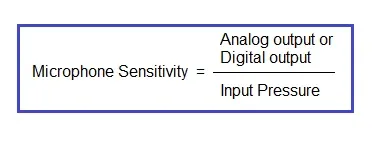
The equation for microphone sensitivity is as follows:
Typically, microphone sensitivity is measured using a 1 kHz sine wave at 94 dB SPL (Sound Pressure Level) or 1 Pa (Pascal) pressure. As mentioned, sensitivity is determined by measuring the magnitude of the analog or digital output signal from the microphone in response to a specific input sound stimulus.
Analog Microphone Sensitivity
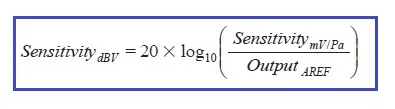
The sensitivity of an analog microphone is calculated using the following equation:
The unit for analog microphone sensitivity is mV/Pa in linear units.
This can also be expressed in dBV (decibels relative to 1 Volt) using the following equation:
Where Output AREF is equal to a reference output ratio of 1000 mV/Pa (i.e., 1 V/Pa).
Digital Microphone Sensitivity
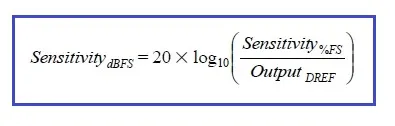
The sensitivity of a digital microphone is calculated using the following equation:
\text{Sensitivity (%)}= \frac{\text{Digital Output Value}}{\text{Full Scale Output}} \cdot 100 \%It’s measured as a percentage of the full-scale output generated by a 94 dB SPL input.
As the output units of analog and digital microphones are different, it can be challenging to directly compare the performance of these two types of microphones.
Continue Learning Microphones: Types, Technology & Comparisons
Deep dives into the components that translate sound waves into electrical signals, covering everything from legacy carbon mics to modern MEMS technology used in smartphones.
- Microphone Basics and Types
- Microphone: Advantages and Disadvantages
- Microphone vs Loudspeaker
- MEMS Microphone Basics
- MEMS Microphone: Advantages and Disadvantages
- Condenser Microphones: Advantages and Disadvantages
- Dynamic Microphones: Advantages and Disadvantages
- Carbon Microphones: Advantages and Disadvantages