
What is Carbon Microphone : Advantages and Disadvantages
Advertisement
A carbon microphone converts sound waves into electrical signals using carbon granules whose resistance changes with pressure. Historically used in telephones and communication equipment, it offers simple construction and high output levels. Advantages include low cost and amplification capability, while disadvantages include poor audio quality and high noise levels.
What is a Carbon Microphone?
Introduction: The carbon microphone represents one of the earliest microphone designs, utilizing carbon granules. Hence the name!
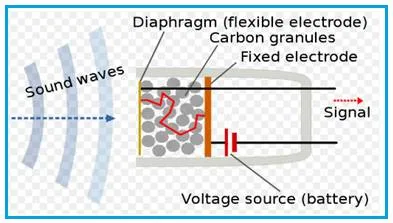
The core principle involves changes in the packing density of these carbon granules in response to sound pressure. When sound pressure increases, the density rises, reducing the electrical resistance between the granules, and vice versa.
 Carbon Microphone
Thomas Edison first patented its use in telephones in 1877. Early wired telephone handsets commonly used carbon microphones.
Figure 1 illustrates a carbon microphone’s key components: a diaphragm (with fixed and flexible electrodes), carbon granules, and a battery.
 Carbon Microphone Working Operation
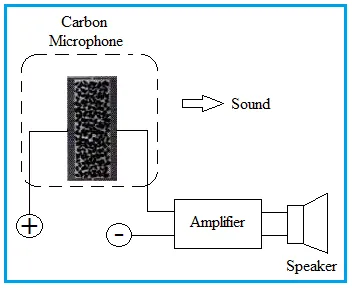
Figure 2 shows how it connects with an amplifier and speaker. Sound waves vibrate the microphone’s diaphragm, generating an electrical signal. This signal is then amplified and sent to a speaker to reproduce the sound. In essence, the carbon microphone converts sound waves into electrical signals, and the speaker performs the reverse process.
Advantages of Carbon Microphones
- High Output Signal: Delivers a strong signal without needing much initial amplification.
- Simple and Rugged: The design is straightforward and durable.
- Simple Working Principle: Easy to understand how it functions.
- Cheap: Relatively inexpensive to produce.
- Easy to Manufacture: The construction process is not complex.
- Tolerates High Sound Pressure: Can handle extremely loud sounds without damage.
Disadvantages of Carbon Microphones
- High Background Noise: Produces significant background noise, often with a crackling sound (“carbon hiss”) that’s hard to eliminate.
- Poor Frequency Response: Doesn’t accurately capture the full range of frequencies.
- Requires Power Supply: Needs a battery or other power source to operate.
- Granule Degradation: Carbon granules can become damaged or fuse together over time.
- Requires Amplification: As previously mentioned, requires an amplifier to boost the signal before it can be reproduced by a speaker.
- Limited Bandwidth: Has a very narrow frequency range.
Summary
Carbon microphones convert sound into electrical signals using carbon granules. Advantages include simplicity and affordability, while disadvantages include noise and limited audio fidelity.
Continue Learning Microphones: Types, Technology & Comparisons
Deep dives into the components that translate sound waves into electrical signals, covering everything from legacy carbon mics to modern MEMS technology used in smartphones.
- Microphone Basics and Types
- Microphone: Advantages and Disadvantages
- Microphone vs Loudspeaker
- Analog vs Digital Microphone Sensitivity
- MEMS Microphone Basics
- MEMS Microphone: Advantages and Disadvantages
- Condenser Microphones: Advantages and Disadvantages
- Dynamic Microphones: Advantages and Disadvantages
- Carbon Microphones: Advantages and Disadvantages