
What is MEMS Microphone : Advantages and Disadvantages
Advertisement
A MEMS microphone is a miniature microphone fabricated using Micro Electro Mechanical Systems technology. It is widely used in smartphones, wearables, hearing aids, and IoT devices. Advantages include compact size, durability, and low power consumption, while disadvantages include limited low frequency response and sensitivity to packaging design.
What is Condenser Microphone?
A condenser microphone employs two thin plates forming a capacitor. One plate is flexible, while the other remains rigid. Equal and opposite charges are applied to these plates. When sound pressure is applied, the capacitance between the plates changes. If the charge is kept constant, the voltage across the plates fluctuates as the capacitance changes.
What is MEMS?
MEMS technology combines electrical and mechanical components on a single chip. These micro-systems offer both sensing and control functionalities.
Key features of MEMS Microphone & its example
MEMS microphones are commonly used in mobile phones. They function on the same principles as condenser microphones but are etched into silicon. A MEMS microphone diaphragm is approximately 1 mm square. These microphones come in two types: analog and digital.
Analog output is amplified on the same chip. Digital output uses either PDM (Pulse Density Modulation) or I2S encoding. PDM represents amplitude variations of the sound wave through bit density and requires an external clock signal.
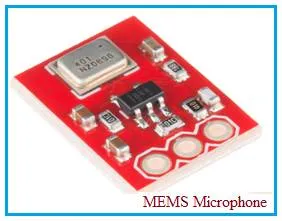
Figure: Analog MEMS microphone (Part number: ADMP401) with preamplifier from Analog Devices Inc.
The INMP401 from InvenSense, Inc. is an omnidirectional microphone with a bottom port and analog output. The ICS-43432 and INMP441 from InvenSense, Inc. are digital MEMS microphones with I2S format. INMP521, INMP522, and INMP621, also from InvenSense Inc., support PDM encoding.
Advantages of MEMS Microphones
Here are the benefits of MEMS microphones:
- Low Power Consumption: They consume very little power.
- Small Size: MEMS microphones are very small.
- High SNR: They offer a high Signal-to-Noise Ratio (SNR).
- Improved Noise Cancellation: They provide better noise cancellation.
- SMT Manufacturing: They can be manufactured using Surface Mount Technology (SMT) and integrated with CMOS processes.
- Robustness: They can withstand high temperatures and vibrations.
- Wideband Frequency Response: They have a flat, wideband frequency response.
- Long Battery Life: They contribute to longer battery life due to low current consumption.
- Sensitivity and Reliability: They offer excellent sensitivity, reliability, and robustness.
Disadvantages of MEMS Microphones
The following are the drawbacks of MEMS microphones:
- Complex Design: The design process is complex.
- Costly Micro-components: Micro-components are expensive compared to macro-components. Mass production is necessary to reduce costs.
- Low Power Transfer: Significant high power transfer is not possible due to their micro size. Preamplifiers or op-amps are often required externally, though sometimes integrated on the same chip.
- Specialized Knowledge Required: Integrating MEMS devices requires specific knowledge and training.
- Brittle Material: Polysilicon, used in construction, is a brittle material. RF scientists are exploring MEMS devices using higher-quality materials that can withstand higher power.
Summary
MEMS microphones provide compact and reliable audio sensing for modern electronics. Advantages include small size and energy efficiency, while disadvantages include performance trade-offs in specific acoustic environments.