
What is RS485 : 5 Advantages and Disadvantages
Advertisement
RS485 is a balanced serial communication standard designed for reliable multi-device communication over long distances in electrically noisy environments. Its advantages include long transmission range, multi-drop networking, and strong noise immunity, while its disadvantages include more complex wiring and the need for proper line termination.
Key Features of RS485 interface
-
RS485 is a serial communication protocol that leverages differential signals for transmitting binary data. It utilizes positive and negative 5V to generate a differential voltage.
-
Compared to RS232, RS485 supports higher data rates and longer distances. It can support distances of up to 1200 meters (approximately 4000 ft).
-
Unlike the one-to-one communication model of RS232, RS485 enables communication with multiple receivers from a single driver.
-
The following table provides a summary of the technical specifications of the RS485 serial interface.
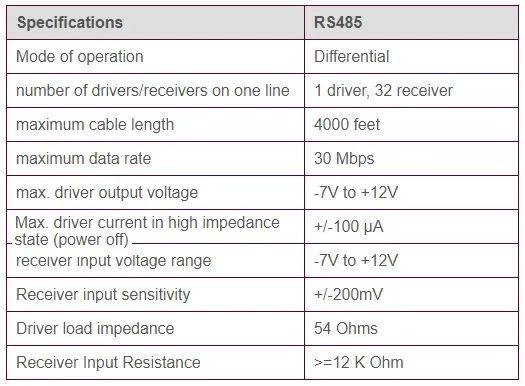
Benefits or Advantages of RS485
-
Long Distance & High Speed: Due to differential signaling, RS485 supports a maximum data transmission speed of 100 Kbps over distances up to 1200 meters (4000 ft).
-
Noise Immunity: Differential signaling makes the RS485 interface highly resistant to noise.
-
Multi-Drop Capability: Supports a single master and multiple slaves (multi-station setup) thanks to its balanced transmission line.
-
Lower Signal Level: Considered a lower signal level interface.
-
Faster Communication: Provides faster communication compared to the I2C protocol.
-
Short Response Time: When fewer than 32 controllers (or readers) communicate on the same data line, the response time between the reader and the software is short.
Drawbacks or Disadvantages of RS485
-
Single Node Transmission: In RS485 mode, only one node can transmit data at any given time.
-
Specialized Cables: RS485 requires specific types of cables, and standard cables are not suitable. These cables are also more expensive compared to CAT5 cables.
-
Wiring Complexity: It requires 4 wires for multidrop communication, unlike RS232, which only needs 2 wires for point-to-point communication.
-
Not Suitable for Large Data Transfer at High Speed: RS485 is not well-suited for transferring large amounts of data at 115.2 Kbps due to potential data loss at such high speeds. Data transfer at 56.2 Kbps is more stable but takes longer.
-
Difficult System Backup: Backing up an RS485 system is difficult because it requires special switches and configurations to build a redundant host PC.
Summary
RS485 is widely used in industrial automation, building management, and process control systems because it provides dependable long-distance communication with excellent interference resistance. Its networking advantages support robust multi-device connectivity, although installation and termination practices significantly influence performance.