
What is Ionospheric Bending in Radio Communication & benefits
Advertisement
Ionospheric bending is the refraction of radio waves as they pass through the Earth’s ionosphere. Variations in ionospheric electron density alter signal paths, affecting satellite communications, GPS accuracy, radar systems and long distance radio propagation. Understanding ionospheric bending is critical for reliable wireless communication performance.
The ionosphere is a region just above our atmosphere where there are a significant number of free electrons and ions. The number of ions and electrons are equal, hence there is no net charge.
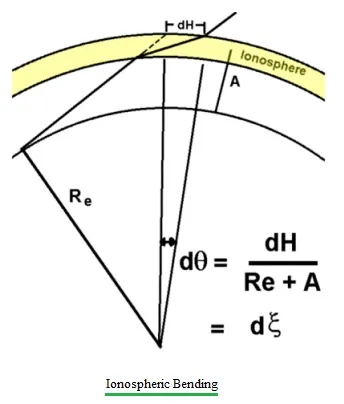
- When a RF (Radio Frequency) signal travels into the ionospheric layer, it experiences refraction due to differences in the density between layers.
- The radio wave experiences a force from ions in the ionospheric layer.
- If the RF signal is incident at the correct angle at this layer, it gets reflected back to our inner atmosphere due to total internal reflection.
- This phenomenon is utilized in mobile communication for radio frequency propagation.
- This ionospheric reflection is called ionospheric bending.
Advantages of Ionospheric Bending in radio communication
Ionospheric bending is the refraction (bending) of radio waves as they pass through the Earth’s ionosphere, a layer of the atmosphere containing charged particles. This phenomenon is especially important for high-frequency (HF) radio communication. Benefits of Ionospheric Bending are as follows.
- Radio waves can be bent back toward the Earth’s surface, allowing signals to travel beyond the horizon. This enables communication over hundreds or thousands of kilometers without satellites
- Multiple reflections between the ionosphere and the Earth allow signals to reach distant countries and continents. This is useful for international broadcasting and maritime communication.
- Long range communication can be achieved without extensive networks of relay stations, towers or cables.
- HF radio systems using ionospheric propagation are generally less expensive than satellite communication for certain applications.
- Provides communication where cellular networks, fiber optic cables, or satellite systems may be unavailable or impractical.
- Can maintain communication during natural disasters when local infrastructure is damaged.
- Supports communication between ships, aircraft, and military units over vast distances without relying on satellites.
- Shortwave radio stations use ionospheric bending to broadcast programs to listeners across large geographic regions.
Wireless & Mobile Communication
- Wireless Communication Basics
- Mobile Communication Hub
- Cellular Communication Basics
- Wireless Communication Terminology
- Advantages and Disadvantages of Wireless Communication
- Understanding Data Rate in Wireless Communication
- Wireless Communication Protocols Comparison
- Wireless Communication Techniques: OFDM, OFDMA, SISO, MIMO
- Fading Basics and Types in Wireless Communication
- FDD vs TDD Difference in Wireless Communication
- Understanding OFDMA Mobile Wireless Communication
- Cyclic Prefix OFDM in Wireless Communication
- Listen Before Talk Wireless Communication
- Standard Wireless Communication and RIS Differences
- Wired vs Wireless Communication Networks
- Path Loss Calculation in Wireless Communication (Calculator)
- Signal and Communication (Calculators Hub)