
What is Signal Integrity: Basics and Advantages
Advertisement
Signal integrity is the ability of an electrical signal to travel through a circuit, PCB or high speed communication channel without distortion, noise, or data loss. Maintaining strong signal integrity is essential for reliable electronic system performance, faster data transmission, reduced errors, and improved product quality. Understanding signal integrity helps engineers optimize designs for efficiency and long term reliability. Let us learn its basics and explore its benefits in VLSI design.
Introduction
Due to advancements in the electronics industry, we see the use of higher clock frequencies and a reduction in signal rise times in PCB and VLSI circuit designs. This leads to various issues due to interconnects, impedance mismatches, signal grounding, and signal losses across the length of the pattern. Signal integrity deals with problems arising due to these issues to meet signal quality, crosstalk, and EMI requirements of the PCBs under design.
What is Signal Integrity?
Signal integrity analysis helps to deal with various issues related to high speed board designs. Examples include USB 2.0 and above, PCI express, DRAM, etc. The signal integrity analysis is applied from the beginning of the circuit design in the schematic window until layout. Changes are made in PCB designs after signal integrity analysis with respect to trace width, trace length, trace spacing, and so on.
The eye diagrams of the signal at appropriate points on the PCB are monitored to check the quality of the signal. The same can also be monitored with the help of an oscilloscope at a later stage after PCB fabrication.
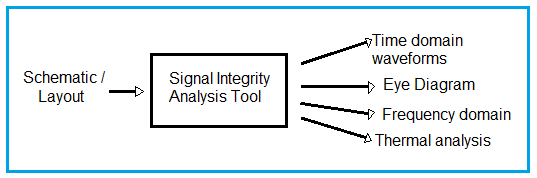
Signal integrity tools help in checking the behavior of signals in nets during schematic design and layout. It helps to identify various parameters such as signal losses on the line, crosstalk between two nets including power and ground balance, rail collapse in power and ground distribution, EMI, and radiation from the entire system, etc.
Tools are available for signal integrity analysis from numerous vendors which include HyperLynx TM from Mentor Graphics, Orcad, SiSoft, Altium, Cadence, Ansys Slwave, and so on. Refer to Signal integrity tools for more information.
Benefits or Advantages of Signal Integrity
Following are the benefits or advantages of Signal Integrity:
- The signal integrity analysis helps to detect layout design issues at the initial stage itself before manufacturing.
- Due to the above reason, it reduces the cost to develop the final product as it avoids unnecessary repetitions of the PCB or IC design.
- Signal integrity helps in resolving issues related to electrical signals such as ringing, signal attenuation, timing, crosstalk, EMI (Electro-Magnetic Interference), noise, etc. This provides good quality signal for routing across the board.
- Signal integrity tools are available at affordable costs with different licensing terms and conditions.
- Signal integrity analysis helps to complete the project in time by resolving design problems much earlier.
Summary
Signal integrity ensures that electrical signals travel accurately through circuits and communication channels without distortion or interference. It plays a critical role in maintaining reliable performance, minimizing data errors, enabling high speed data transfer and improving the overall efficiency, quality, and reliability of modern electronic systems.
Advertisement


