
What is differential signaling : 5 Advantages and Disadvantages
Advertisement
Differential signaling is a data transmission method that uses two complementary signals to represent information. This two wire signaling interface is widely employed in high speed communication standards such as USB, Ethernet, LVDS, and PCIe. Advantages include excellent noise immunity and signal integrity, while disadvantages include increased wiring complexity and higher implementation costs.
Key Features
- It’s a type of balanced signaling.
- The signal is measured by the difference between the positive and negative sides.
- Differential signals generally have lower distortion compared to single-ended circuits.
- It’s used to transmit information electrically using two complementary signals.
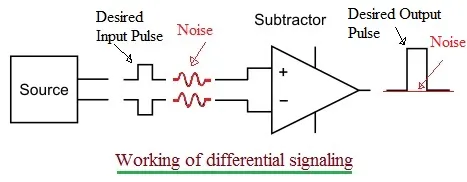
- The receiver responds to the difference in electrical potential between the two signals, rather than the difference between a signal wire and ground (as in single-ended signaling). As shown above, input signals are combined, while noise signals are suppressed by the differential receiver.
- Differential signaling is used in both analog and digital systems:
- Analog Differential Signaling: Balanced Audio
- Digital Differential Signaling: Twisted pair, PCIe, DisplayPort, USB, HDMI, RS-422, RS-485
Advantages of Differential Signaling
Following are the key benefits of differential signaling.
- EM Interference Resistance: It’s resistant to electromagnetic (EM) interference because the signals are transmitted on balanced lines.
- Reduced Crosstalk: Helps minimize electronic crosstalk between signals.
- High-Speed Transmission: Well-suited for high-speed transmission lines due to noise elimination and reduced radiation. This leads to better common-mode rejection and improved power supply rejection.
- Higher Signal Swings: Can achieve larger overall signal swings.
- Harmonic Cancellation: Offers inherent cancellation of even order harmonics. Pre-distortion techniques can further reduce odd harmonics.
Disadvantages of Differential Signaling
Following are some of the drawbacks of differential signaling.
- Increased Trace Count: The most obvious disadvantage is that it requires two traces instead of one for each signal, essentially doubling the board area required.
- More Conductors for Multiple Signals: When transmitting multiple signals, the number of conductors required is higher than with single-ended signaling. For example, transmitting 8 differential signals requires 16 conductors, plus a ground conductor for a common ground between sender and receiver. Single-ended signaling would only need 9 conductor wires in the same scenario.
Summary
Differential signaling offers superior noise immunity, reduced electromagnetic interference and better signal integrity over long distances, making it ideal for high speed and high reliability applications. However, it comes with increased complexity, higher cost, and requires more wiring compared to single ended signaling. Despite these drawbacks, its benefits often outweigh the limitations in critical communication systems.