
What is a Resistive Touch Screen: 5 Advantages and Disadvantages
Advertisement
A resistive touch screen is a pressure-sensitive input device that detects touch by measuring electrical contact between two conductive layers. Its advantages include compatibility with gloves or styluses and lower manufacturing costs, whereas its disadvantages include lower optical clarity and reduced multi-touch capability.
Introduction : A touch screen is essentially a video display with integrated touch sensors, functioning as a pointing device like a mouse or trackpad. It reports both position and pressure, making it a versatile input method. Touch screens are commonly found in smartphones, tablets, photocopiers, and laptops. The two primary types are resistive and capacitive touch screens.
Resistive Touch Screen working principle
A resistive touch screen comprises two transparent layers placed over a standard video display. Each layer possesses uniform electrical resistance. When a user presses the outer layer (layer-1) with a fingertip, it makes contact with the inner layer (layer-2) at that specific point.
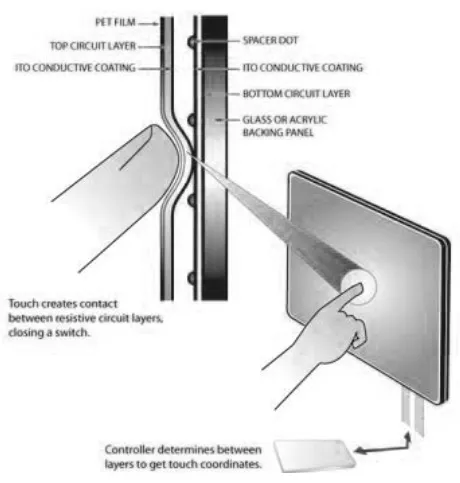
Both four wire and five wire resistive touch screens are available. For a deeper dive into touch screen technology and a comparison of different panels, refer to touch screen technology basics.
Benefits of Resistive Touch Screens
- Lower Cost: They are generally less expensive than capacitive touch screens.
- Dust and Water Resistance: Resistive screens are highly resistant to dust and water, making them suitable for rugged environments.
- Versatile Input: They work equally well whether the user is wearing gloves or using a stylus.
- Simple Interface: Easy to integrate with mobile phones, tablets, and other devices.
- Handwriting Recognition: Well-suited for handwriting recognition applications.
Drawbacks of Resistive Touch Screens
- Lower Sensitivity: They are less sensitive and require more pressure to register a touch. Some versions even require a stylus.
- Poor Contrast: Resistive screens tend to have lower contrast compared to other technologies.
- Single-Touch Input: They only respond to one touch location at a time and do not support multi-touch gestures. Two-finger gestures are not possible.
- Vulnerable to Damage: The flexible membrane can be damaged by sharp objects.
Summary
Resistive touch screens provide a practical and economical user interface for industrial equipment, medical devices, and embedded systems. Their operational advantages remain valuable where durability and precision are prioritized over advanced multi-touch functionality.