
What is Micro LED : Advantages and Disadvantages
Advertisement
Micro LED is an advanced display technology that uses microscopic light emitting diodes as individual pixels to produce bright, energy efficient, and high contrast images. It is emerging in premium televisions, wearables, and AR devices. Advantages include exceptional brightness and longevity, while disadvantages include high manufacturing complexity and cost.
Structure and features of Micro LED
Micro LED technology utilizes miniaturized LEDs arranged in a matrix. It’s considered a next-generation display technology, often referred to as MicroLED, mLED, or μLED.
Micro LED displays are composed of numerous microscopic LEDs that self-illuminate for each display pixel, similar to OLED panels. In essence, individual micro LEDs, ranging in size from 1 to 10 µm, are transferred in large quantities onto an IC substrate. This substrate can be rigid, flexible, transparent, or opaque. Each LED unit is smaller than 100 micrometers, and each pixel is individually addressed and driven to emit light.
Micro LEDs leverage inorganic materials like Gallium Nitrate (GaN), which are self-emitting and don’t require a backlight for operation.
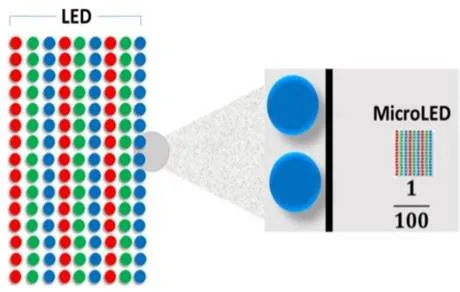
When a forward bias is applied, electrons from the semiconductor’s conduction band recombine with holes from the valence band, releasing photons that emit monochromatic colored light.
Micro LED technology finds applications in a wide range of products, including wearable devices, smartwatches, smartphones, augmented reality (AR), virtual reality (VR) headsets, 8K UHD TVs, large video displays, laptops, and tablets.
Benefits or Advantages of Micro LED
- Higher Efficiency and Brightness: Micro LEDs offer higher luminous efficiency, enhanced brightness, and faster response times thanks to the use of inorganic materials.
- High Reliability and Contrast: The technology boasts high reliability and delivers superior contrast.
- Smaller Size and Lighter Weight: Due to its self-illuminating nature, Micro LED doesn’t require a backlight, resulting in smaller, lighter, and thinner displays that consume less power.
- Wide Viewing Angles: Micro LED offers wide viewing angles, providing a more comfortable viewing experience.
- Longer Lifespan and Environmental Stability: Micro LEDs offer a longer operational life and greater environmental stability.
- Faster Refresh Rates: The technology provides very fast refresh rates, with short response times typically measured in nanoseconds.
- Flexible Design: Micro LEDs can be constructed using curved or flexible backplanes.
- High Resolution: It offers high resolution and pixel density for sharper images.
Drawbacks or Disadvantages of Micro LED
- High Manufacturing Costs: The specialized machinery and facilities required for manufacturing Micro LEDs make the process expensive.
- Immature Mass Transfer Technology: Mass transfer technology, crucial for efficient production, still requires further development. This currently hinders the widespread commercial availability of Micro LED products.
Summary
Micro LED displays deliver superior image quality, efficiency, and durability. Advantages include high brightness, contrast, and lifespan, while disadvantages include expensive production processes and limited commercial availability.
Continue Learning LED Technologies & Displays
Deep dives into Light Emitting Diodes, including micro-LEDs, OLEDs, and how they compare to traditional LCD screens.
- Surface Emitting LED
- Edge Emitting LED
- Double Heterojunction (DH) LED
- Polymer LED: Construction, Working, Advantages & Disadvantages
- Micro-LED vs Mini-LED
- Understanding LED Lifespan and Life Expectancy
- HID Bulb vs LED Bulb
- COB LED Basics
- LED Tube Types: A, B, C
Use Cases of LEDs : Health Monitoring & More
- LED Light Therapy Benefits
- Health Monitoring: LEDs & Photodiodes
- Motion Sensor LED Bulbs: Pros and Cons