
What is Capacitive Touch Screen : 5 Advantages and disadvantages
Advertisement
A capacitive touchscreen uses the electrical properties of the human body to detect touch inputs. It is commonly found in smartphones, tablets, kiosks, and industrial displays. Advantages include excellent responsiveness and multi-touch capability, while disadvantages include reduced usability with gloves and higher manufacturing costs compared to resistive screens.
Introduction : A touch screen is essentially a video display with integrated touch sensors. It functions as a pointing device, similar to a mouse or trackpad, but offers the added ability to report pressure alongside position. Touch screens are widely used in devices such as smartphones, tablets, photocopiers, and laptops. Two prevalent types are resistive and capacitive touch screens.
About Capacitive Touch Screen
Capacitive touch screens typically consist of two layers of glass separated by a space. These layers are coated with a conductor, such as Indium Tin Oxide.
The human body acts as an electrical charge conductor. When a user touches the glass surface, it alters the electrostatic field. The system then monitors the precise location of the touch based on the movement of tiny capacitors.
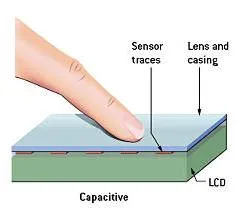
Capacitive touch screens can also be constructed from an array of individual touch sensors printed on a glass panel as vertical and horizontal lines of transparent conductive ink. Alternatively, some smaller capacitive screens measure the minute amount of current drawn by a fingertip from four sources positioned at the corners of the touch screen.
For a deeper understanding of touch screen technology, refer to resources covering the basics and comparisons between different touch screen panel types.
Advantages of Capacitive Touch Screens
- Improved Visuals: The use of a glass layer contributes to a sharper and brighter display.
- High Sensitivity: Capacitive screens are highly sensitive and typically don’t require a stylus for operation.
- Multi-Touch Support: They support multi-touch gestures, allowing for more complex interactions.
- High Clarity and Resolution: Capacitive screens offer excellent clarity and resolution for a better viewing experience.
- Sealability: They can be completely sealed, offering protection against dust and moisture.
Disadvantages of Capacitive Touch Screens
- Glove Incompatibility: Because they rely on the conductive nature of human touch, they don’t function when the user is wearing gloves.
- Higher Cost: They are generally more expensive compared to resistive touch screens.
- Fragility: The glass construction makes them more susceptible to breakage, often necessitating the use of tempered glass screen protectors.
Summary
Capacitive touchscreens offer responsive multi-touch interaction for modern devices. Advantages include accuracy and durability, while disadvantages include glove limitations and higher costs.