
What are Radar Speed Signs: 5 Advantages and Disadvantages
Advertisement
Radar speed signs are electronic traffic management devices that detect approaching vehicle speeds using radar technology and display them to drivers in real time. Their advantages include promoting safer driving behavior and reducing speeding incidents, whereas their disadvantages include reduced effectiveness with habitual offenders and dependence on proper installation and maintenance.
Key features of Radar Speed Signs
Radar speed signs, also known as radar feedback signs, speed feedback signs, radar signs, and “Your Speed” signs.
- As the name implies, radar speed signs display the speed of vehicles approaching them.
- They are constructed using LEDs, radar hardware, and a power source (typically batteries).
- Their primary function is to alert drivers to slow down when their speed exceeds the posted speed limit.
- They serve as a traffic calming device, effectively reducing accidents by encouraging lower speeds, often more effectively than speed bumps due to the visual feedback provided by flashing LEDs.
- They can be powered by battery packs, solar power, or AC power.
- Available in various display sizes (e.g., 11”, 13”, and 17”).
- Often support Bluetooth and Wi-Fi, allowing control via mobile apps.
- Ideal for use in school zones, busy industrial sites, and construction zones.
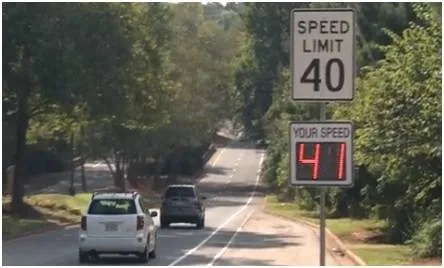 Radar speed sign
- Operate in the K band (18 to 27 GHz) and can detect vehicles up to approximately 1200 feet away.
- Typically have a detection range of about 5 to 127 MPH.
- Operate within a specific beamwidth (e.g., 12 degrees +/- 2 degrees) with a defined accuracy (e.g., +/-1 MPH), depending on the design.
Benefits or Advantages of Radar Speed Signs
- Enhanced Safety: They offer a safer alternative to speed bumps, which can be irritating, cause discomfort, and lead to unpredictable traffic speeds as some vehicles may not slow down adequately.
- Real time Feedback: They provide drivers with immediate feedback, prompting them to switch from “autopilot” mode to a more alert state. This encourages speed reduction and helps prevent accidents. Studies have shown speed reductions from 50 mph to 30-35 mph after installation.
- Easy Installation: They can be easily installed on existing poles, the back of vehicles, mobile petrol stands, etc. Their portable and rugged design, combined with their light weight, facilitates quick installation (often within a minute). This makes them particularly useful for road and utility construction crews.
- Weatherproof Operation: They are designed to operate reliably 24/7 in all weather conditions, unlike speed bumps.
- Battery Backup: Units often come with two batteries, each providing approximately 7 days of backup power.
- Wireless Connectivity: Bluetooth connectivity allows for convenient control via mobile phones or tablets using dedicated apps. This enables adjustment of parameters like speed units (mph or km/h), stealth mode, LED brightness, and operational schedules.
- Theft and Vandalism Resistance: Designed with theft resistance in mind, they typically use roundhead security bolts for fixing and feature lockable enclosures. Many are also bulletproof to deter vandalism.
- Traffic Data Collection: They can generate valuable reports for traffic police, including vehicle counts, peak traffic times, and speed violations.
- Regulatory Compliance: Most radar speed signs are certified under regulations like FCC Part 15, meaning they don’t require an operating license.
Drawbacks or Disadvantages of Radar Speed Signs
- Cost: They can be expensive, although they are often available at half the price of a speed trailer.
- Limited Detection Range: The radar speed sign can only detect vehicles at a maximum distance of 1200 feet using its K-band operating frequency.
- Effectiveness in Congested Traffic: When there are numerous vehicles traveling at varying speeds, the effectiveness of the radar speed sign can be diminished.
- Beamwidth and Accuracy Limitations: They operate within specific beamwidth and accuracy ranges, which can impact performance.
- Speed Range Limitations: They can only detect vehicle speeds within a certain range (e.g., 5 to 127 mph).
Summary
Radar speed signs have become an effective traffic calming solution by encouraging voluntary speed reduction without direct law enforcement intervention. Their strengths include improved road safety, enhanced driver awareness, and lower operating costs, while certain limitations such as environmental influences and driver compliance should be considered during deployment.
Explore More Radar Use Cases (Applications)
- Active Radar Homing : Key Advantages & Disadvantages
- UWB Radar Based Child Presence Detection
- Radar Target Simulator
- Semi-Active vs. Passive vs. Active Radar Homing
Continue Learning Radar Technology
- Radar Tutorial: Types and Applications
- Radar Architecture Components & Functions
- Radar Duplexers: Types and Functionality
- Radar Classifications or Types
- Radar : Key Advantages & Disadvantages
- Radar Frequency Bands Chart
- Radar - Transmitter & Receiver Measurements
- Active Radar Vs. Passive Radar : Key Differences
- Radar Terminologies