
What is Active Radar Homing : Advantages and Disadvantages
Advertisement
Active radar homing is a guidance technique in which a missile uses its own onboard radar transmitter and receiver to detect, track, and engage a target. Advantages include autonomous target tracking and improved accuracy, while disadvantages include higher system complexity, increased cost, and susceptibility to electronic countermeasures.
Introduction
Active radar homing is a guidance system used in Air-to-Air missiles. It consists of a ground radar system with a large antenna, an active radar launch pad housing multiple radar-guided missiles, and the active radar missile itself. The ground radar can be either fixed or mobile. Fixed radars, typically installed at a specific location, are often referred to as air surveillance radars.
Unlike semi-active radar homing missiles that only contain a radar receiver, active radar guided missiles incorporate a radar transceiver. A transceiver is a device that combines both transmitter and receiver functionalities.
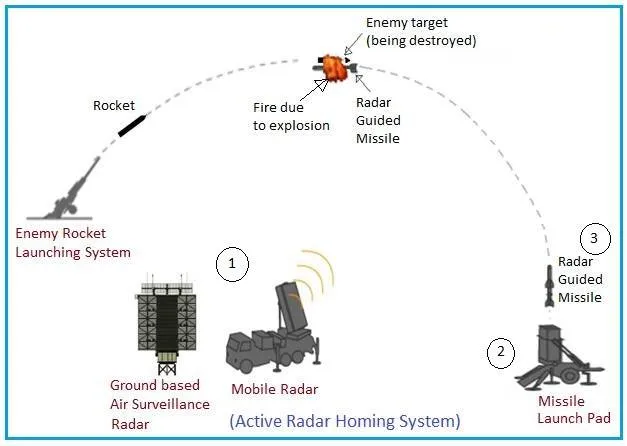 Active Radar Homing Missile System
The image above illustrates the components of an active radar homing system: a fixed or mobile radar, a missile launch pad, and the radar-guided missile.
How it Works
Here’s a breakdown of the active radar homing system’s operation:
- Ground Radar Illumination: The ground radar station continuously emits electromagnetic energy into the air. This energy reflects off of targets that enter its range.
- Target Detection and Missile Launch: Once the ground radar system detects a target at long range, it signals the missile launch pad to release an air-to-air missile towards the target.
- Onboard Radar Activation: As the radar-guided missile approaches the target, it uses its onboard radar transceiver to refine its range and get much closer.
- Target Destruction: Ideally, the air-to-air radar-guided missile detonates near the target, destroying it and any other rockets in the vicinity. Direct hits are also possible.
Advantages of Active Radar Homing
- Increased Accuracy: It’s more accurate than land-to-air missiles guided solely by ground-based radar.
- Proximity to Target: The onboard radar transceiver allows the missile to get very close to the target, significantly increasing the probability of a successful destruction.
- Launch Platform Independence: Once fired, the missile autonomously tracks and destroys the target. This frees up the launch platform to track other targets.
Disadvantages of Active Radar Homing
- Higher Cost: The use of a radar transceiver makes it more expensive compared to semi-active radar homing systems.
- Lower ERP and Limited Range: Because the missile uses battery power for its operation, it has a lower Effective Radiated Power (ERP) and a limited coverage range.
- Reliance on Ground Radar for Long Range Targets: It’s not effective for hitting long-range targets without the initial assistance of a ground-based radar system.
Summary
Active radar homing enables autonomous target tracking using onboard radar systems. Advantages include high accuracy and independence, while disadvantages include complexity, cost, and electronic interference risks.
Explore More Radar Use Cases (Applications)
- UWB Radar Based Child Presence Detection
- Radar Speed Signs : Key Advantages & Disadvantages
- Radar Target Simulator
- Semi-Active vs. Passive vs. Active Radar Homing
Continue Learning Radar Technology
- Radar Tutorial: Types and Applications
- Radar Architecture Components & Functions
- Radar Duplexers: Types and Functionality
- Radar Classifications or Types
- Radar : Key Advantages & Disadvantages
- Radar Frequency Bands Chart
- Radar - Transmitter & Receiver Measurements
- Active Radar Vs. Passive Radar : Key Differences
- Radar Terminologies