
What is Passive IoT : Applications & Benefits
By RF Wireless Expert Team
Advertisement
Passive IoT is a batteryless IoT technology in which devices communicate using harvested energy from ambient sources or dedicated RF signals. By eliminating the need for batteries, Passive IoT reduces maintenance costs, improves sustainability, and enables scalable deployment for applications such as asset tracking, logistics, retail management and smart supply chains. Passive IoT is considered the evolution of RFID technology and forms an important component of future Ambient IoT ecosystems.
How Passive IoT Works
- A passive IoT tag consists of Antenna, Integrated circuit and Sensor (optional).
- When a reader transmits an RF signal.
- The tag harvests energy from the signal.
- The chip becomes active.
- Data is transmitted back through backscatter communication.
Key Features
- No battery required
- Extremely low cost
- Lightweight design
- Long operational life
Applications
- Supply Chain Management : Asset tracking, Inventory management
- Logistics : Package monitoring, Warehouse automation
- Retail : Smart shelves, Anti-counterfeit systems
- Healthcare : Medical equipment tracking, Pharmaceutical monitoring
Advantages of Passive IoT
- Very low manufacturing cost
- Zero battery maintenance
- Long lifespan
- Easy deployment
Disadvantages of Passive IoT
- Limited communication range
- Dependence on readers
- Restricted processing power
- Lower data rates
Key differences
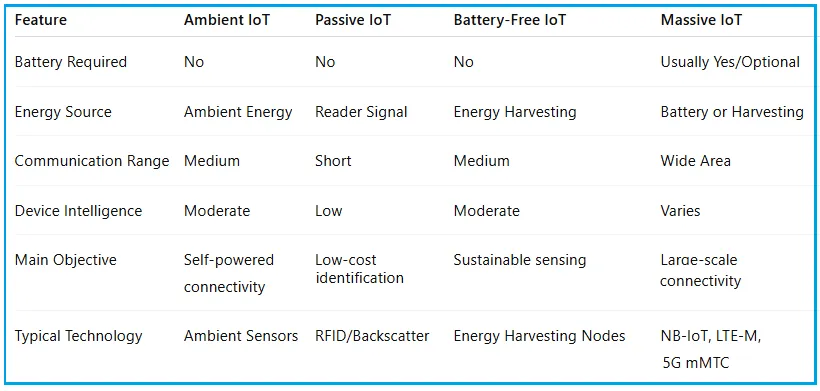
Summary: Passive IoT enables ultra low cost connectivity through batteryless communication.
Continue Learning IoT Basics, Architecture & Tutorials
- IoT Tutorial: Basics, Architecture & Protocol Stack
- Understanding IoT Architecture: Levels 1 to 5
- IoT Stack vs Web Stack
- Advantages, Disadvantages, and Applications of IoT
- Ambient IoT : Advantages & Disadvantages of A-IoT
- Physical Layer Security for IoT Networks in 6G
- IoT Wireless Technologies and Standards
Hardware: IoT Sensors, Actuators & SoCs
- Understanding IoT Sensors
- Understanding IoT System-on-Chip (SoC) - RS9113
- Classification of IoT Devices
- Actuator Types: IoT Guide
- Soft Actuators in IoT
- IoT Antenna Types
Real-World IoT Applications & Systems
- Top 10 Applications of IoT
- IoT Based Smart City Architecture
- IoT Based Healthcare System Architecture
- IoT Weather Monitoring System Architecture
- IoT Smart Retail System Architecture
- IoT Air Pollution Monitoring System Architecture
- IoT Based Intelligent Traffic System
- IoT in Manufacturing
- Smart Lavatory IoT: Aircraft Cleanliness Monitoring
- Satellite IoT Network Architecture
- Cellular IoT Overview