
Mobile Battery Charger Explained
Advertisement
Battery is the source of energy for the mobile phone circuitry and subsystems. The success of battery technologies greatly depends on the battery material, float life, temperature stability, and safety. Most mobile phone battery packs have a rating of 3.6 V, 650 mAH.
Performance of a mobile battery is measured in terms of talk time (in dedicated mode) and standby time (in idle mode). Cell phone batteries have different weight, lifetime, talk time, and thickness. Batteries are available either in primary cell form or rechargeable battery form.
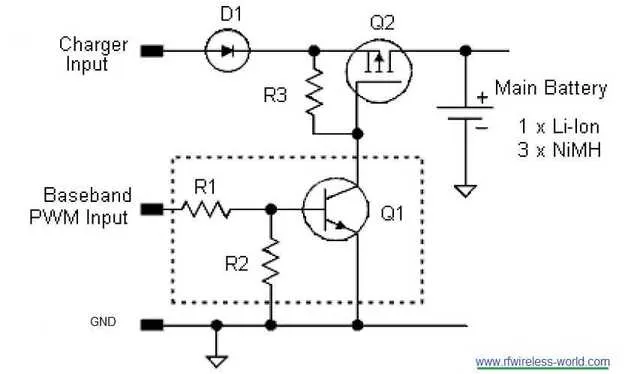
Rechargeable batteries are made using materials such as NiCd (Nickel Cadmium), NiMH (Nickel Metal Hydride), Li-Ion (Lithium-Ion), and Li-Polymer (Lithium Polymer). The following figure depicts a typical mobile battery charger circuit used widely for charging the batteries of mobile phones.
Battery Types & Technologies (Li-ion, LiPo, LiFePO4)
Explore the most common battery chemistries used in modern electronics, from consumer gadgets to electric vehicles.
- Lithium-Ion Batteries: Advantages & Disadvantages
- LiFePO4 vs Li-Ion Battery: Key Differences
- LiPo Battery: Advantages & Disadvantages
- Sodium-Ion Batteries Overview
- Sodium-Ion vs Lithium-Ion Batteries
- Lead Acid Batteries: Advantages & Disadvantages
- Tubular vs Flat Plate Battery
Advanced & Emerging Battery Tech
Discover the cutting edge innovations powering the future, including biodegradable materials, wearables and nuclear cells.
- Bio-Battery: Construction, Working, Advantages & Disadvantages
- Paper Battery: Construction, Working, Advantages & Disadvantages
- Iron-Air Batteries: Advantages & Disadvantages
- Nuclear Batteries: Advantages & Disadvantages
- Printed Batteries vs Conventional Batteries
- Flexible Batteries: Advantages & Disadvantages
- Wearable Battery: Advantages & Disadvantages