
LED Tube Types: A, B, and C Explained
By RF Wireless Expert Team
Advertisement
LED lighting has exploded in popularity, thanks to its long lifespan, energy efficiency, and ease of control. But navigating the world of LED tubes can be a little confusing, especially when you start seeing terms like Type-A, Type-B, and Type-C. This article breaks down the differences between these LED tube types.
LED Tube Type-A
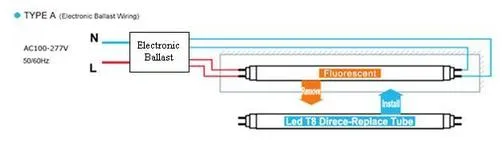
Features of LED tube type-A:
- Uses an existing electronic ballast.
- Operates on 100-277V AC at 50/60 Hz.
- Requires ballast replacement during maintenance.
- Considered to have a “risk of fire and electrical shock”.
- Needs both ballast and lamp holder replacements.
- Essentially, Type-A tubes are designed to be a relatively simple replacement for fluorescent tubes, utilizing the existing ballast.
LED Tube Type-B
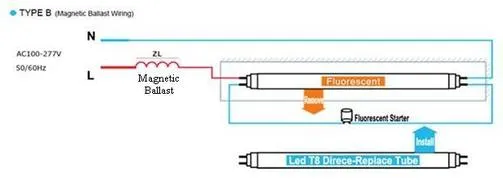
Features of LED tube type-B:
- Uses a magnetic ballast.
- Operates on 100-277V AC at 50/60 Hz.
- Designed to operate with an internal driver, but can also be directly connected to mains power.
- Incoming power lines are directly connected to sockets, potentially exposing individuals to AC voltage.
- Also carries a “risk of fire and electrical shock”.
- Type-B tubes often bypass the ballast altogether, requiring some rewiring for direct connection to the mains.
LED Tube Type-C
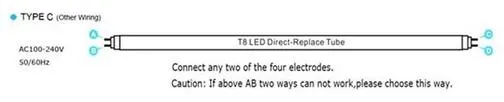
Features of LED tube type-C:
- Does not use any ballast.
- Operates on 100-249V AC at 50/60 Hz.
- Uses an external driver and requires a modified fixture compared to Type-A and Type-B.
- Low voltage outputs from the driver are connected to sockets instead of the line voltage used in Type-A and Type-B.
- Fixture input wires must be interfaced with the driver.
- Type-C solutions use an external driver to power the LED tube which is a safer, low voltage option.
Continue Learning LED Technologies & Displays
Deep dives into Light Emitting Diodes, including micro-LEDs, OLEDs, and how they compare to traditional LCD screens.
- Surface Emitting LED
- Edge Emitting LED
- Double Heterojunction (DH) LED
- Polymer LED: Construction, Working, Advantages & Disadvantages
- Micro-LED vs Mini-LED
- Understanding LED Lifespan and Life Expectancy
- HID Bulb vs LED Bulb
- COB LED Basics
Use Cases of LEDs : Health Monitoring & More
- LED Light Therapy Benefits
- Health Monitoring: LEDs & Photodiodes
- Motion Sensor LED Bulbs: Pros and Cons