
What is Surface Emitting LED: Structure, Working, Advantages & Disadvantages
Advertisement
A surface emitting LED is a semiconductor light-emitting device that radiates light perpendicular to the chip surface instead of from its edges. Its advantages include uniform light emission, compact packaging, and efficient optical coupling, whereas its disadvantages include limited output power and relatively complex fabrication processes.
Surface Emitting LEDs (Light Emitting Diodes) are widely utilized in optical communication systems due to their straightforward design and efficient optical coupling capabilities.
Surface Emitting LED Structure & Working Operation
-
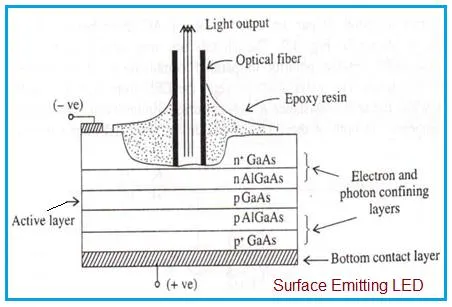
The Surface Emitting LED is a modified form of the Double Heterojunction (DH) LED. In this design, the optical fiber is butt-coupled directly to the LED. (See Figure 1)
-
The structure consists of a thin central active layer of p-type GaAs.
-
This central layer is bounded by n-type AlGaAs / n+-type GaAs on the top side.
-
On the bottom side, the central layer is bounded by p-type AlGaAs / p+-type GaAs.
-
The topmost n+-type GaAs and the bottom p+-type GaAs layers are used exclusively to provide low-resistance ohmic contacts.
-
The external optical fiber is connected by etching the top layers and shielding with epoxy resin.
-
When the refractive indices of both p-type and n-type materials are the same, light is free to exit from all sides of the semiconductor due to the absence of confinement. However, only the active region near the surface emits a significant amount of light while the rest of the device absorbs light. This is why it is known as a “Surface Emitting LED.”
-
The output radiation originates from the central thin layer (p-type GaAs layer).
-
The maximum optical power (Pc) coupled with the optical fiber is expressed as follows:
Pc = π * (1-R) * A * Rs * (NA)^2
Where:
- R = Reflection loss at the fiber surface
- A = Fiber cross-section area
- Rs = Radiance amount from the source
- NA = Numerical Aperture
Benefits or Advantages of Surface Emitting LEDs
-
High Optical Coupling Efficiency: The optical coupling coefficient between the LED and the external fiber system is relatively high, resulting in better optical coupling efficiency.
-
Low Optical Loss: Internal absorption is minimal due to carrier recombination occurring near the top heterojunction.
-
Suitable for Long Wavelength Applications: InP/InGaAsP-based LEDs are used for applications requiring long wavelengths.
-
High Efficiency & Radiance: Offers higher efficiency and can operate at both low and high radiance levels.
-
Low Thermal and Contact Resistance: The top n-GaAs contact layer ensures low thermal resistance and contact resistance. This allows for high current densities and high radiation intensity.
-
Good Forward Radiance: The internal absorption within the device is very low because of the larger bandgap confining layers. Furthermore, the high reflection coefficient at the back crystal face results in good forward radiance.
Drawbacks or Disadvantages of Surface Emitting LEDs
-
Lower Data Rate: Surface Emitting LEDs typically transmit data at rates lower than 20 Mbps, which is less than that of Edge Emitting LEDs.
-
Short Optical Link with Large NA: They are characterized by a short optical link and a large Numerical Aperture (NA). This may limit their suitability for long distance communication.
Summary
Surface emitting LEDs are widely used in optical communication, display technology, sensing, and illumination because they provide consistent light output and compact integration. Their optical advantages support efficient device design, although manufacturing precision and power limitations influence application suitability.
Continue Learning LED Technologies & Displays
Deep dives into Light Emitting Diodes, including micro-LEDs, OLEDs, and how they compare to traditional LCD screens.
- Edge Emitting LED
- Double Heterojunction (DH) LED
- Polymer LED: Construction, Working, Advantages & Disadvantages
- Micro-LED vs Mini-LED
- Understanding LED Lifespan and Life Expectancy
- HID Bulb vs LED Bulb
- COB LED Basics
- LED Tube Types: A, B, C
Use Cases of LEDs : Health Monitoring & More
- LED Light Therapy Benefits
- Health Monitoring: LEDs & Photodiodes
- Motion Sensor LED Bulbs: Pros and Cons