
What is LTE-M : Advantages and Disadvantages
Advertisement
LTE-M (LTE Cat-M1) is a cellular IoT technology optimized for low-power devices requiring mobility, voice support, and extended coverage. It is widely used in asset tracking, wearables, and smart city applications. Advantages include low power consumption and mobility support, while disadvantages include lower data rates than traditional LTE services.
LTE-M Architecture & its Key Features
LTE-M adheres to 3GPP specifications, similar to LTE technology. It stands for Long Term Evolution for Machine-Type Communications. It’s primarily designed to meet the objectives of cellular IoT devices, such as low device cost, deep coverage, longer battery life, and higher cell capacity.
LTE-M, along with NB-IoT, are two LPWA (Low Power Wide Area) technologies tailored for IoT applications. They facilitate the transmission/reception of small data packets using lower bandwidth at reduced costs. These technologies find applications in various sectors, including smart buildings/cities, healthcare, people/asset/animal tracking, and pollution monitoring.
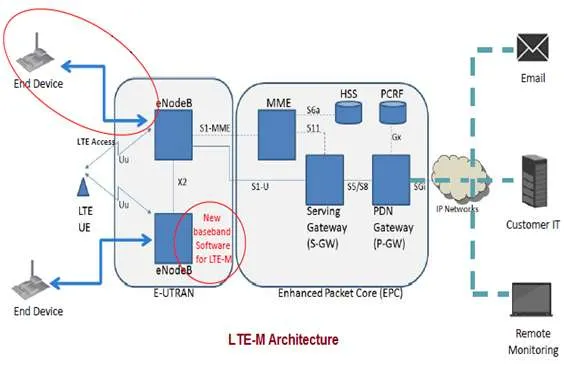
LTE-M devices are categorized into Cat-0, Cat-M1, and Cat-M2, as defined by different 3GPP releases. LTE-M Cat-0, Cat-M1, and Cat-M2 follow 3GPP TS 36 series of rel.12, rel.13 and rel.14 respectively. The figure above illustrates the LTE-M system architecture and the necessary modifications from the standard LTE architecture. Cat-M1 features are highlighted in the table below.
LTE-M Cat-M1 Features
| Feature | Description |
|---|---|
| Bandwidth | 1.4 MHz (Maximum 6 PRBS are allocated in DL/UL equivalent to 1.08 MHz) |
| Peak Data Rate (DL/UL) | 1 Mbps |
| Coverage | Upto 11 Km |
| Duplex modes | HD-FDD, FD-FDD, TDD |
| Number of receive antennas | 1 |
| Transmit power | 20 dBm |
| Advanced power saving modes | PSM, eDRX |
| Modulation (Highest) | 16-QAM |
| Coding scheme (DL/UL) | Turbo code |
| Spatial Layers (Max. in DL/UL) | 1 |
| Maximum TBS (DL/UL) | 1000 bits |
| CE Modes | Mode-A(Mandatory), Mode-B (Optional) |
Benefits or Advantages of LTE-M
- Low-bandwidth IoT Applications: Ideal for IoT applications requiring small data transfers using low bandwidth at low costs.
- Excellent Coverage: Provides particularly good coverage, especially in the USA.
- TCP/IP Connectivity: Uses TCP/IP, enabling connection to any server.
- Faster Data Rates: Offers faster data rates compared to some other LPWA technologies.
- Power Efficiency: Designed to be highly power-efficient, resulting in longer battery life for devices. Power-saving modes like PSM and eDRX further enhance battery performance.
- Easy Deployment and Interoperability: Easy to deploy and interoperable with existing LTE networks.
- High Capacity: Supports a large number of devices per cell.
Drawbacks or Disadvantages of LTE-M
- Higher System Costs: System costs can be higher than some other LPWA technologies.
- No IPSec Integration: IPSec is not incorporated.
- IPR Risks and Certifications: Potential IPR risks and certification requirements can be concerns.
- Power Consumption During Firmware Upgrades: Carrier firmware upgrades can consume significant power.
- Not Suitable for Large Data Transfers: Not suitable for applications requiring large amounts of data.
- Lower Data Transfer Speeds: Doesn’t offer the very high-speed data transfer capabilities of other cellular technologies like 4G or 5G.
Summary
LTE-M delivers cellular IoT connectivity with improved coverage and battery life. Advantages include mobility support and efficient power usage, while disadvantages include limited throughput compared to broadband LTE.
Continue Learning LTE-M Technology
- LTE-M basics tutorial
- LTE-M Architecture
- LTE-M Frame Structure
- LTE-M Frequency Bands
- LTE-M Channel Types
- LTE-M Protocol Stack
- LTE-M System Timers
- LTE-M Device Categories
- LTE-M RRC Procedure
- LTE-M Power Savings
- LTE-M Advantages & Disadvantages