
LTE-M CE Mode A vs CE Mode B: Coverage Enhancement Explained
Advertisement
This page delves into the differences between CE (Coverage Enhancement) Mode A and CE Mode B in LTE-M (Long Term Evolution for Machines), a technology designed for IoT (Internet of Things) devices. These modes were introduced in 3GPP Release 13 specifically to enhance coverage.
Introduction to LTE-M and Coverage Enhancement
LTE-M aims to provide a cellular communication solution tailored for IoT devices. To address the unique challenges of IoT deployments, particularly regarding coverage, LTE-M employs coverage enhancement techniques. These challenges include:
- Complexity Reduction: LTE-M devices reduce complexity using techniques such as single antenna reception and lower maximum transmit power. However, these simplifications can degrade performance and lead to coverage loss compared to standard LTE.
- Challenging Coverage Conditions: LTE-M devices often need to operate in environments with poor signal strength and require better coverage than regular LTE.
CE Mode A and CE Mode B are designed to overcome these challenges, offering different levels of coverage enhancement.
LTE-M CE Mode A
CE Mode A is designed to provide moderate coverage enhancement, offering a balance between performance and power consumption. Key features include:
- Repetitions: Supports 32 subframe repetitions of the data channel (PDSCH and PUSCH). This repetition increases the probability of successful data transmission in poor signal conditions.
- Bandwidth: PDSCH and PUSCH use a bandwidth of 1 to 6 PRBs (Physical Resource Blocks) in CE mode A.
- Coverage Enhancement: Offers sufficient CE to compensate for simplifications implemented by low-cost LTE-M devices. It also provides some additional CE beyond normal LTE coverage.
- Optimization: Optimized for moderate CE, achieved through a relatively small number of repetitions.
- SRS Transmission: Supports both periodic and aperiodic SRS (Sounding Reference Signal) transmission. SRS helps the base station estimate the uplink channel quality.
LTE-M CE Mode B
CE Mode B provides a deeper level of coverage enhancement compared to Mode A, suitable for more challenging environments. Key features include:
- Repetitions: Supports 2048 subframe repetitions of the data channel (PDSCH and PUSCH). The significantly higher number of repetitions offers improved robustness in extremely poor signal conditions.
- Bandwidth: PDSCH uses a bandwidth of 4 to 6 PRBs in CE mode B. PUSCH uses a bandwidth of 1 or 2 PRBs.
- Coverage Enhancement: Provides deep coverage compared to CE mode A, needed in more challenging coverage conditions.
- Optimization: Optimized for substantial CE, achieved through a large amount of repetition.
- Mode Support: If a device supports CE mode B, it also supports CE mode A.
- SRS Transmission: Does not support SRS transmission, but will use shortened formats for PUSCH / PUCCH (Physical Uplink Control Channel).
MCS and TBS for PDSCH and PUSCH in LTE-M
Here are the tables illustrating Modulation and Coding Schemes (MCS) and Transport Block Size (TBS) values for PDSCH and PUSCH channels in LTE-M CE Modes A and B:
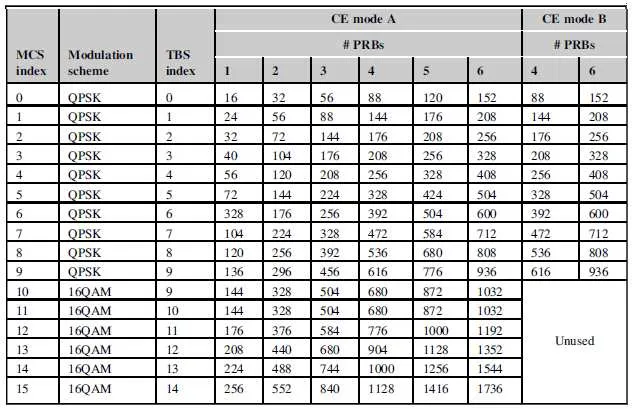
Table-1: PDSCH Modulation and Coding Schemes and TBS in LTE-M
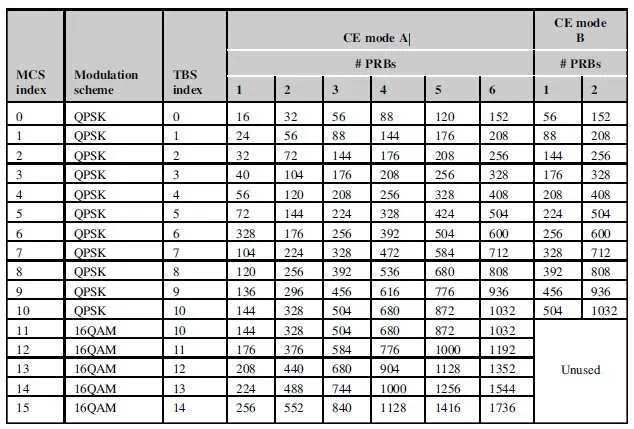
Table-2: PUSCH Modulation and Coding Schemes and TBS in LTE-M
These tables show the different modulation and coding schemes and corresponding transport block sizes used for PDSCH and PUSCH in CE Mode A and Mode B, impacting the data rates and robustness of the connection.
Key Considerations for CE Mode Selection
- All low-cost LTE-M devices (with categories Cat-M1 and others) must support CE mode A. Support for CE mode B is optional.
- Devices operate in CE mode only when required to maintain connectivity, i.e., when they are outside the normal LTE coverage range.
- When devices are within normal LTE coverage, they use normal LTE operation instead of CE mode, leveraging the high performance (low latency, high data rates) of standard LTE.