
What is I2C : Advantages and Disadvantages
By RF Wireless Expert Team
Advertisement
I2C (Inter Integrated Circuit) is a popular serial communication protocol used to connect microcontrollers, sensors, EEPROMs, and peripheral devices using only two wires i.e. SDA and SCL. It supports multiple devices on a shared bus. Advantages include simple wiring and low cost, while disadvantages include limited speed and bus length restrictions.
Key features of I2C Interface
- I2C stands for Inter-Integrated Circuit.
- It utilizes only two lines for communication between multiple masters and multiple slaves: SDA (Serial Data) and SCL (Serial Clock).
- I2C supports various data rates, with versions ranging from 100 Kbps to 400 Kbps, 1 Mbps, and even 3.4 Mbps.
- It’s a synchronous communication protocol, similar to SPI but unlike UART. This means a common clock signal is shared between masters and slaves.
- It employs start and stop bits, as well as an ACK bit, for every 8 bits of data transferred.
- In an I2C interface, all masters can communicate with all slave devices.
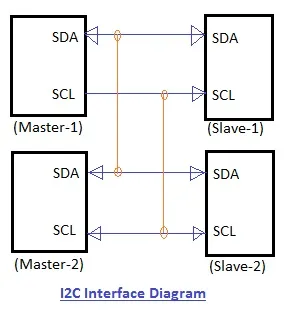
I2C interface diagram
Benefits or Advantages of I2C
- Multiple Master Devices: The circuit can accommodate more than one master device.
- Fewer Wires: I2C requires only two wires for communication, unlike SPI which needs four. This reduces the number of interconnections between ICs, leading to fewer pins and PCB tracks.
- Smaller PCBs: Reduced wiring translates into smaller and less expensive PCBs.
- Simplified Addressing: The addressing scheme is straightforward and doesn’t necessitate CS (Chip Select) lines for adding extra devices, unlike SPI.
- Easy Expansion: Adding new devices to the bus is very simple.
- Flexible Voltage: It employs an open collector bus design, allowing flexibility in voltage usage on the bus. Slew rates are also limited.
- Flow Control: I2C incorporates flow control mechanisms.
- Easy Debugging: Diagnosis and debugging are relatively easy, making it simple to trace any malfunctions.
- Hot Swapping: ICs can be added or removed from the hardware without affecting other circuits on the bus.
Drawbacks or Disadvantages of I2C
- Increased Hardware Complexity: The hardware becomes more complex as the number of master/slave devices increases in the circuit.
- Half-Duplex Communication: It operates in half-duplex mode, meaning data can only be transmitted in one direction at a time.
- Software Overhead: The protocol is managed by a software stack, which increases processing overhead on the microcontroller (µC) or microprocessor (µP).
Summary
I2C is a widely used two-wire communication protocol for embedded systems. Advantages include easy implementation and multi-device support, while disadvantages include slower data rates and limited scalability for high-speed applications.