
What is Homodyne Receiver : Advantages and Disadvantages
Advertisement
A homodyne receiver, also called a direct conversion receiver, converts an incoming RF signal directly to baseband using a local oscillator operating at the same frequency as the received signal. It is widely used in modern wireless devices. Advantages include simple architecture and integration, while disadvantages include DC offset and noise sensitivity.
Homodyne Receiver Architecture
A Homodyne receiver doesn’t use an RF mixer to convert the modulated RF signal to baseband I/Q signals. The baseband signals are at zero frequency.
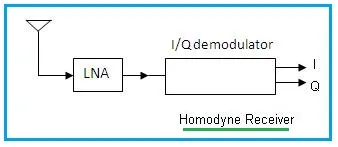
Figure 1: Homodyne Receiver architecture
The figure above depicts a typical Homodyne Receiver architecture.
A Homodyne receiver uses a Local Oscillator (LO) frequency that’s the same as the received signal frequency.
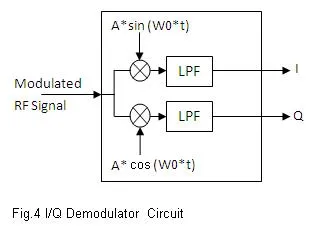
Figure 2: IQ demodulator
The figure above depicts an IQ demodulator. As shown, it converts the modulated RF signal into baseband I and Q signals. Here, W0 equals 2πF0 where F0 is equal to Fc (the Carrier Frequency) of the received modulated RF signal.
Benefits or Advantages of Homodyne Receiver
- It uses the same frequency for the LO as the transmitted RF frequency for conversion to zero baseband I/Q signal frequency. Hence, it has a very simple architecture.
- RF components such as LOs, RF mixers, and filters are not needed, unlike in a heterodyne receiver architecture. This means the cost of a homodyne receiver is less compared to a heterodyne receiver.
Drawbacks or Disadvantages of Homodyne Receiver
- Homodyne receivers suffer from LO (Local Oscillator) leakage. This leakage needs to be as low as possible in order to retrieve the baseband I/Q signals at zero frequency.
Summary
Homodyne receivers simplify RF signal processing through direct frequency conversion. Advantages include low cost implementation and compact design, while disadvantages include DC offset issues and susceptibility to interference.