
What is Forward Converter : Advantages and Disadvantages
Advertisement
A forward converter is an isolated DC-DC converter that transfers energy directly from the transformer to the output during the switch on period. It is widely used in medium power power supplies and telecom equipment. Advantages include better efficiency and lower ripple than flyback converters, while disadvantages include more complex circuitry and additional reset winding requirements.
Introduction to DC to DC Converter
A DC-DC converter is an electronic circuit whose main function is to modify one potential difference (i.e., voltage) level to another. It’s essentially a voltage regulator consisting of switches, an inductor, and a capacitor for power conversion.
DC-DC converters have numerous applications and can be divided into the following types based on isolation between input and output circuits:
- Isolated DC-DC converter
- Non-isolated DC-DC converter
Isolated DC-DC converters are further divided into subtypes:
- Flyback
- Forward
- Half bridge
- Full bridge
- Push Pull
Forward Converter Circuit and Working Operation
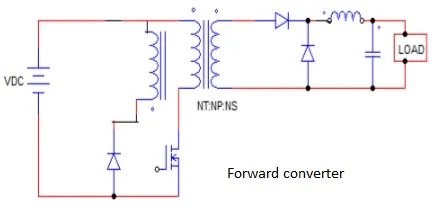
Forward converter circuit
The figure above depicts a forward converter circuit. It’s a form of DC-DC converter similar to flyback and half-bridge converters. It can deliver an output voltage that is either higher or lower relative to the input voltage, along with electrical isolation.
The single-transistor forward converter is commonly used for off-line power supplies in the power range below 200W. Its simplicity and low component count make it a viable alternative to the flyback converter whenever galvanic isolation is required. It can also be used to step up or step down the potential.
The forward converter is usually a good choice when high output current is required. These converters produce symmetrical AC waveforms across the first section winding of the transformer. Therefore, core flux is excited bi-directionally, leading to better employment of the magnetic core and resulting in an increased power rating.
Advantages of Forward Converter
Following are some of the benefits of a Forward converter:
- Better Transformer Utilization: The forward converter transfers energy instantly across the transformer and doesn’t rely on energy storage. The resulting lower peak currents in the primary and secondary mean lower copper losses compared to a flyback converter. The transformer can be made more ideal with a much higher magnetizing inductance and no air gap.
- Reduced Output Voltage Ripple: The output inductor and freewheeling diode keep the output current fairly constant, dramatically reducing the secondary ripple current. As a result, the output voltage ripple is also reduced significantly.
- Lower Active Device Peak Current: Due to the much larger magnetizing inductance, the active device peak current is lower.
Disadvantages of Forward Converter
Following are some of the drawbacks of a Forward converter:
- Increased Cost: Requires additional output electrical devices and a freewheeling diode, increasing the overall cost.
- Minimum Load Requirements: Particularly with multiple outputs, the gain changes dramatically if the device goes into Discontinuous Conduction Mode (DCM) operation at light loads.
- Higher Voltage Demand for MOSFET: The higher voltage demand for the MOSFET often discourages its use in off-line applications that need to operate on 230V grids.
Summary
Forward converters provide efficient isolated power conversion for medium power applications. Advantages include improved efficiency and output performance, while disadvantages include increased circuit complexity and transformer design requirements.